Saturday, 18 July 2009

House of Lords Committee on the Barnett Formula

The House of Lords Select Committee on the Barnett Formula (the Richard Committee) published its report yesterday. The Barnett formula is the formula which distributes block grant to the devolved administrations in Scotland, Wales and Northern Ireland for the funding of devolved matters. It does this mechanically, by apportioning a percentage of any increase of expenditure in England in any financial year on those matters to the block grant paid to the devolved administrations.

The Committee recommend that the Barnett formula should be scrapped and a needs based formula substituted for it to distribute funding on devolved matters. The Committee have come up with their own formula based on a combination of the relative number of infants (under 5s), children (5s to 16s), pensioners (over 65s), the level of child poverty, household income, unemployment, disability, and mortality rates. It concludes:

"The main points of note here are as follows:

  • On most measures, the levels of relative need in England and Scotland are quite similar (that is, the blue and the white lines are usually quite close to one-another). England has slightly higher levels in matters to do with children and poverty and Scotland has much higher levels regarding disability and mortality.
  • With the main exception of mortality, need in Wales is usually higher than in Scotland (that is, the red line is usually outside the blue one).
  • Reflecting its young population, need in Northern Ireland is high on the children measures and low on the pensioner measure. In this combination of highest need on some measures and lowest need on others, Northern Ireland is unique."

In comparison with the Barnett formula, the general effect is that on the Committee's needs measure, people in England would not see their position changed to any great extent in terms of share of overall UK resources, people in Scotland would see less, people in Wales would see more (although even now they receive more per capita than do those in England albeit less than Scotland) and I am not clear about the position on Northern Ireland - the Committee's proposal is probably broadly neutral for Northern Ireland because the administration there already receive considerably more per head than the rest of the UK under the Barnett formula. Broadly therefore, the Committee's proposed formula would transfer some of Scotland's block allocation to Wales.

What is the chance of this being implemented? Next to zero. The Treasury are against the changes: their spokesman said about the report "The Barnett formula has served the UK well over the years. It has proved to be a robust mechanism for allocating spending to the devolved administrations and has stood the test of time". This reflects Treasury evidence given to the Committee. Whilst David Cameron has recently made some noises about looking to revise Barnett, he has also said that this ought to be on the basis of consensus and generally agreed principles.

It would be unfair to label the Committee's proposed needs formula by reference to the axiom "Garbage in, garbage out". But any particular outcome under the Committee's proposals is highly dependent on what indexes of "need" are chosen and how they are measured. The Committee suggest that respective needs can be settled in accordance with recommendations made by a new "independent" UK Funding Commission. The problem is both that such a Commission could never and should never be independent because any needs-based funding formula requires taking a view on social priorities, which would inevitably and rightly have to be subject to political control, and that the temptation for politicians to tweak the inputs to achieve previously determined and desired outputs would probably be irresistible. By contrast, the Barnett formula is purely mechanical - find out what the uplift or reduction in England in any financial year has been on devolved matters, and apply a proportion of the same uplift or reduction to the block grant to the devolved administrations.

But the main problem, and the one probably causing the Treasury to pour cold water on it, is the likely impossibility of achieving agreement. First, the Committee's approach would not cater for those in England who, rightly or wrongly, see themselves as unfairly treated (an overlooked majority) as a source of subsidy for the rest of the UK. Secondly, there is no way that the Scottish government will do anything other than oppose it - their "remedy" to the Barnett formula is fiscal autonomy for Scotland. Thirdly, it is difficult to see the Tories, with their miserable Scottish representation, wanting to reignite claims that they are an "anti-Scottish" party by cutting Scottish block grant in comparison with the rest of the UK as one of their first actions should they take office after the next general election, particularly as all devolved block grants will almost certainly be cut anyway in proportion to the ramping down of UK public expenditure from next year to cope with the ballooning of the national debt. Fourthly, any tweaking of funding arrangements within the UK is likely to give rise to fresh calls for some of the other constitutional anomalies affecting England to be remedied, which the current Labour government would like to avoid in their own self interest, particularly as in the lobbying that would inevitably be made to the proposed independent Commission with respect to how funds should be shared out, someone somewhere would need to be seen to be standing up for people in England in the same way that the devolved administrations would undoubtedly stand up for their own people.

The fact is that devolved government has heightened sensitivities between the constituent parts of the UK and this has resulted in the making of revisions of the Barnett formula having become too hot a political potato to handle. "Do nothing" would probably be the favoured course for any government in the forseeable future.

Saturday, 4 July 2009

Parliamentary Standards Bill

The government introduced the Parliamentary Standards Bill into the House of Commons on 23rd June. It completed its Commons' stages and passed to the House of Lords on 2nd July.

It has been criticised by some newspapers and commentators as a piece of poorly conceived legislation given inadequate Parliamentary time. Some have even claimed that it is a constitutional affront to Parliament. Some have rejoiced over the loss at Report stage of clause 10 of the Bill as introduced (see further below on clause 10). These criticisms appear to have been formed on the basis that the Bill comprises an inadequately considered knee-jerk reaction to the Parliamentary expenses scandal, but in my view they are for the most part unwarranted and, in the case of clause 10 of the Bill, based on a lack of understanding of the legal and constitutional background. The Daily Telegraph came up with an editorial on Thursday which was vastly overblown, and which I analyse a little further below.

That is not to say that the Bill has not been improved during its Committee and Report stages in the Commons: it has, particularly in relation to the proposed new MPs' code of conduct relating to financial matters, which was sketchily dealt with in the Bill as first introduced. But as passed to the Lords it seems to me to be in a workmanlike shape, or rather will be once clause 10 is reinserted in the Lords, as surely needs to happen for the reasons mentioned below.

What the Bill does

The Bill as passed to the House of Lords does three main things:
  • it creates the Independent Parliamentary Standards Authority
  • it creates the office of Commissioner for Parliamentary Investigations
  • it creates new offences concerning the conduct of MPs
The IPSA has the role of setting the allowances (ie expenses) that members may claim in relation to the carrying out of their duties by reference to a scheme which it is to prepare after appropriate consultations. It is to be noted that although the IPSA would pay MPs' salaries, it would not be concerned with determining their amount, which will continue to be set by resolutions of the House itself. Likewise, the IPSA is not concerned with MPs' pensions.

In addition the IPSA is to prepare a code of conduct for MPs' financial interests, also after appropriate consultations. The Bill requires that the code should include provision stopping MPs being "bought", such as by speaking or advocating for a person or body for payment, and for a register of MPs' financial interests. Members will retain a role in relation to the code prepared by the IPSA, because under the Bill it has to be approved by resolution of the House before it comes into force. That seems to me to be a reasonable balance.

The Commissioner is responsible for investigating whether breaches of the code on financial interests have occurred. The IPSA can require a member to repay sums found by the Commissioner to have been wrongly paid. The procedures to be followed are to be set down by the IPSA.

While failures to comply with the code will be punishable by the House, not all failures will comprise criminal offences. The Bill provides for new offences where a member knowingly makes a false claim, indulges in improper paid advocacy or fails to register an interest required by the code. The first of these (false claims) is at first sight odd, because subject to Article 9 of the Bill of Rights, which I deal with further below, deliberately making false expenses claims would generally already be an offence under the Fraud Act 2006.

The creation of the new Independent Parliamentary Standards Authority and a separate office of Commissioner for Parliamentary Investigations is intended to separate the roles of propounding the rules of conduct applying to members and the investigation of failures to comply with it. It is for debate whether this separation is necessary but it cannot it seems to me to be a source of criticism apart from perhaps being overly complicated. At best it emphasises the impartial nature of the investigation of MPs' conduct; at worst the separation does nothing very much. I would hope that by now most are of the view that it can no longer be left to MPs acting together to police themselves - doctors and lawyers, for example, have no longer done so far a number of years.

Clause 10

Clause 10 of the Bill as introduced said this:

"No enactment or rule of law which prevents proceedings in Parliament being impeached or questioned in any court or place out of Parliament is to prevent—
(a) the IPSA from carrying out any of its functions;
(b) the Commissioner from carrying out any of the Commissioner’s functions;
(c) any evidence from being admissible in proceedings against a member of the House of Commons for an offence under section 9."

This clause is intended to override, for the limited purposes stated, Article 9 of the Bill of Rights 1689, which provides "That the freedom of speech and debates or proceedings in Parliament ought not to be impeached or questioned in any court or place out of Parliament"

The Daily Telegraph said this about it in an editorial:

"MPs would have dispensed with one of the foundations of parliamentary democracy: the privileged protection afforded to Members to speak their minds in the Chamber without fear of prosecution in the courts. It is not suggested that MPs should be above the law of the land, which, after all, they set and to which the rest of us are subject; and there is a clear need for tighter controls to prevent MPs misusing their allowances. But that is not an argument for wholesale constitutional upheaval."

Clause 10 would cause no constitutional upheaval of any kind. On its terms, were the editorial writer to have troubled to read them, he or she would have found that it would not affect the immunity of members when speaking their minds in debates. The exclusion of Article 9 only related to matters done by the IPSA or the Commissioner (not members) and to evidence brought in prosecutions of members for an offence of making false claims of expenses, failing to register interests or conducting paid advocacy.

One of the problems of Article 9 of the Bill of Rights is that what comprises a "proceeding" in Parliament which benefits from its protection is not clear. We know on the one hand from decided cases on defamation that it does not include most correspondence a member has with his or her constituents; and on the other hand it clearly covers things said in the House or one of its Committees, and also papers distributed to Committees. There is a large grey area in between. Arguably Article 9 might prevent MPs' expenses claims from being investigated by the Commissioner or, following such an investigation, a prosecution being brought where the claims were found to be fraudulent, and it would make no sense to make these new offences in the Bill subject to such hazards which might prevent any satisfactory prosecution. Article 9 would almost certainly prevent prosecutions of MPs relating to the new offence of paid advocacy, except in so far as the Bill is to be treated as impliedly overriding Article 9. Why leave it to implication?

My main complaint about this aspect of the Bill relates to the new offence of making false expenses claims. But for the Article 9 point, if proven this would already comprise an offence under the Fraud Act 2006, and the 2006 Act has a higher penalty than does an offence under the Bill. Rather than this particular new offence being provided for, it would be better in my view for the Bill to override Article 9 in respect of evidence relating to any offence arising under the 2006 Act relating to an MP's allowances, so permitting a normal fraud prosecution to be brought.

I do not necessarily object to members still being able to set their own salaries - someone has to do it. But nonetheless I think the manner in which salary recommendations are prepared and on which the House will resolve should be more clearly set out. They should in my view be subject to independent recommendation and review notwithstanding that the final decision may remain with members of Parliament.

Friday, 26 June 2009

The cycle of life

It is only in the second half of my life that I have grown to like dogs. There were two things which persuaded me in the end: first, the invention of "pooh bags" and the bins for them introduced by local Councils in their parks (full marks to the work done by the local authorities and doggie organisations on this), which mean that dogs do not have to create an unpleasant and unhygienic mess, and secondly my younger son who wrote me an essay setting out 20 reasons why we should get a dog.

Our family dog Midge died 6 weeks ago, after a lengthy illness with Cushings Syndrome (she was an Affenpinscher, and you will see why she was called Midge from the picture). We have all felt immense grief: despite her small size she packed a big punch in character, playfulness and affection. For the nearly 9 years she was with us, she was one of the family, doing what we did and accompanying us on our outings. A picnic on a nice summer's day will never be quite the same without her.

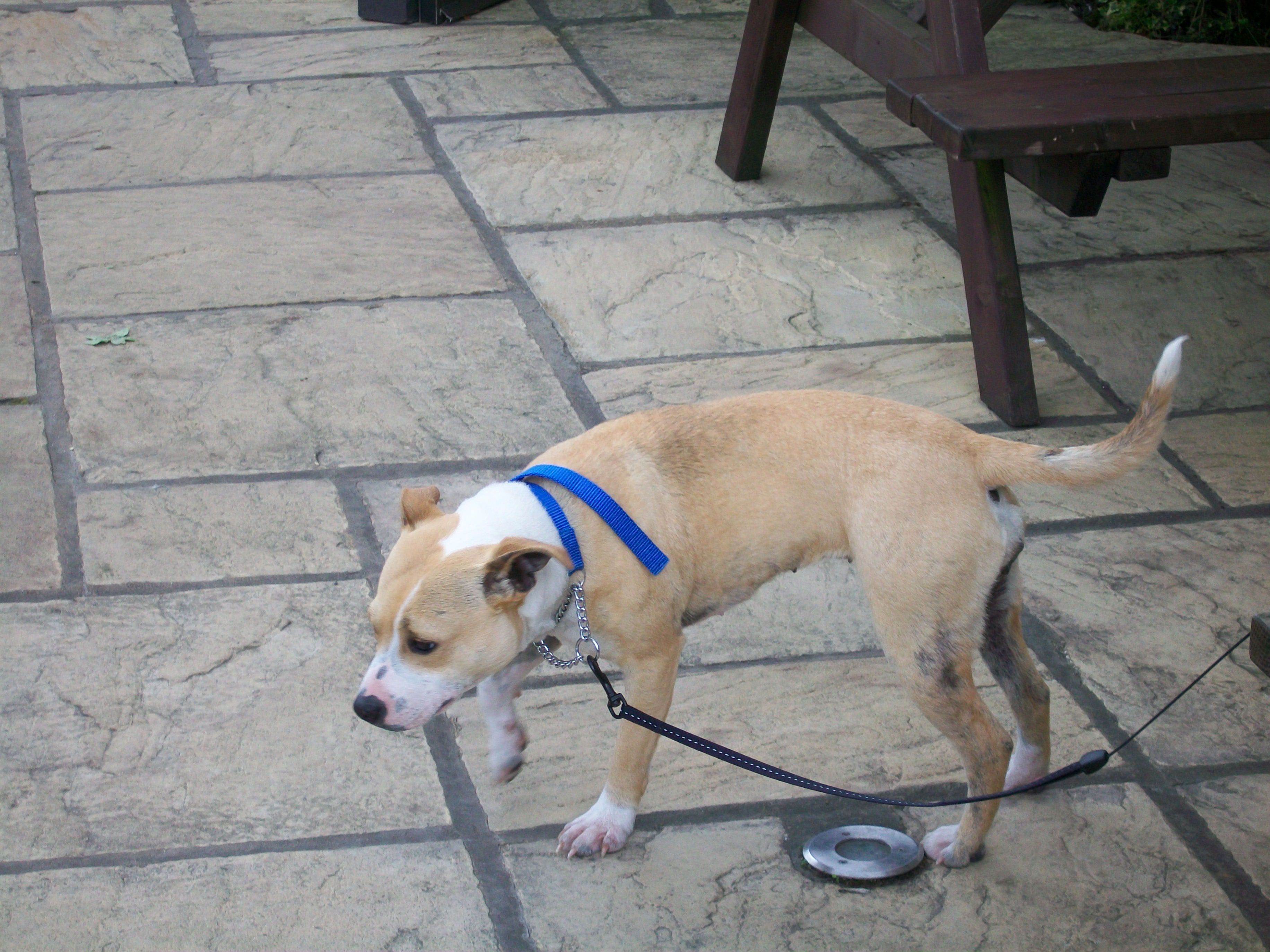
The good memories remain, but happily as time moves on the grief diminishes. We have just taken on another dog Clarrie, seen in the picture on her first trip to the pub. She was a rescue dog from the RSPCA, mostly Staffie with a whiff of something else (she is a bit too small to be a full-blood Staffie). She is about one year old, and despite her difficult early life she is equable, friendly and definitely likes people and their companionship. We have her booked into the dog therapist next week, but there don't seem to be many snags to be addressed. She is also fast - on our nearby cycleway (a disused railway line) she can run as fast as I can cycle.

I was impressed by the business-like approach of the RSPCA to their work. I have been one of those who have sometimes felt a bit uncomfortable in the past about the attention and resources some devote to animals, given the awfulness that life offers to some of our fellow human beings around the world. On the other hand dogs can be real friends, both to families and to those living alone, and family pets can help children develop their skills in receiving and giving affection. I strongly suspect also that the people who would be cruel to animals are probably the same people who would be cruel to their fellow human beings, including children. The decent treatment of animals seems to be part of what being civilised is about. I suppose what is needed is a balance in all things.

Wednesday, 17 June 2009

Calman, taxation and representation

In my earlier article on the Calman report, I suggested that the proposal of the report that national rates of income tax as fixed by the UK Parliament should be 10% lower in Scotland than in the remainder of the UK, with the Scottish government and Parliament having the power to make up that missing 10% (and more) with a Scottish income tax to whatever degree it thinks fit, was a sleight of hand with respect to Scottish nationalists.

It is worth mentioning that the same is probably true in relation to those in England or Wales who are concerned by the West Lothian Question, or more generally by constitutional issues concerning the link between taxation and representation.

One of the outcomes of the English civil war was that it finally established that no taxation could be imposed without the authority of Parliament. The King could no longer tax in reliance on the Royal Prerogative, a matter which caused great difficulties to Charles II's administration after the Restoration. This was further entrenched in the Bill of Rights 1689 following the Glorious Revolution, Article 4 of which provides "That levying money for or to the use of the Crown by pretence of prerogative, without grant of Parliament, for longer time, or in other manner than the same is or shall be granted, is illegal".

The need for a link between taxation and representation also formed one of the calls to arms of the revolutionaries in the War of American Independence. The revolutionaries objected to being subject to taxes, and in particular stamp and excise taxes, without representation within the body which fixed them, namely Parliament. In doing so they relied on the Parliamentarian cause in the Civil War that "what an English King has no right to demand, an English subject has a right to refuse" (from the case concerning the extension of Ship Money) and on the rights established by Article 4 of the Bill of Rights. In the period before the outbreak of the Revolutionary War in America, the colonists in objecting to such taxation saw themselves as asserting their rights in defence of the British constitution and the Bill of Rights, rather than acting to subvert that constitution.

The effect of the Calman proposals is that MSPs in the Scottish Parliament must set the rate of income tax for those in Scotland, with the proviso that it is not to be more than 10% below the rate set for the rest of the UK by the UK Parliament (they can set it at any amount above that rate). Since it is pretty well inconceivable that a Scottish government would want to fix a rate of income tax more than 10% below the rate applying elsewhere in the UK, this limitation could be seen as a fig leaf to justify members of the UK Parliament for Scottish constituencies continuing to have a say on the rates of income tax applying outside Scotland. Likewise, the inability of the Scottish Parliament under the proposals to change the differential between higher and lower income tax bands might also be as much to do with keeping some link to the rates of income tax fixed for elsewhere in the UK for West Lothian purposes as with a desire to save the rich in Scotland from unwelcome depredation.

In any event, under the Calman proposals there would be no link to UK rates, for stamp duty land tax, airport passenger tax, aggregates levy and landfill tax applying in Scotland.

Of course, the call of "no taxation without representation" is not necessarily synonymous with "only those representing those paying it are to determine the amount of a tax". What one can say though is that the proposal that the Scottish Parliament should set the rates of income tax, stamp duty land tax, airport passenger tax, aggregates levy and landfill tax applying in Scotland rather than the UK parliament raises constitutional issues for the UK which somewhat belies the Calman Commission's view that it does not need to consider the West Lothian question in making its recommendations, and that it only need concern itself with the position of those in Scotland.

The UK government appears to be taking the line that no referendum in Scotland is required to give effect to the Calman proposals on tax, given that there is already a power for the Scottish Parliament to vary income tax by 3% upwards or downwards so that the principle has already been established. (The original 1998 Act referendum in Scotland covered whether this since unused 3% power should be conferred or not).

However, there is cause to consider whether for constitutional reasons it would be desirable for there to be a referendum within the rest of the UK on the assymetrical taxation autonomy which is now proposed in the report.

Tuesday, 16 June 2009

Calman Report

The Calman Commission reported yesterday. The report, although 268 pages long, is quite a good read, with a perceptive analysis of the difficulties of achieving stable devolution to individual nations within the UK such as Scotland, given the way in which the UK has taken shape since the Acts of Union of 1707 and the unequal sizes and economic resources of its constituent parts.

The Calman recommendations


The report will be a disappointment for those hoping for a step on the road to Scottish independence. Gordon Brown has described it as "bold and realistic". Realistic, perhaps; but bold, no. From the unionist perspective I would characterise it is a clever and well conceived sleight of hand.

The report proposes some additional devolution of powers in a few areas: some further road traffic responsibilities such as alcohol limits and traffic speeds are to go to Hollyrood, together with the control of air powered weapons. Some other rather esoteric matters are proposed to go back to Westminster, such as company liquidation and the regulation of health professionals. But the headline change proposed is that national rates of income tax as fixed by the UK Parliament should be 10% lower in Scotland than in the remainder of the UK, with the Scottish government and Parliament having the power to make up that missing 10% (and more) with a Scottish income tax to whatever degree it thinks fit. In addition, it is proposed that the Scottish government should be able to fix its own rates of stamp duty land tax on property transfers, together with its rates of airport passenger tax, aggregates levy and landfill tax.

As a corollary of this, it is proposed that the Scottish government is also to be able to borrow for capital items to be financed out of these new revenue powers.

Why do I describe this as a sleight of hand? I do so because the Scottish Parliament already has the power to vary the rate of income tax applying in Scotland up or down by up to 3%. This power has remained dormant and unused: no Scottish government has wanted to make active choices between cutting public expenditure and taxation on the one hand and increasing taxation and public expenditure on the other hand. Implementation of the Calman proposal would force the SNP in government to show its hand on whether it is a low tax or high tax government, or whether it is to "cop out" of separate national aspiration by following the rates which are set at Westminster for the remainder of the UK. In short, it forces the making of active choices, and it does so without the Scottish government being able to make up the "missing 10%" by imposing a rate of tax which impinges proportionately more heavily on higher rate payers than on lower rate payers. (Adopting Dennis Healey's famous epithet as Chancellor, it cannot adopt a policy of funding public expenditure by taxing higher earners "till the pips squeak".)

In consequence of the diversion of the top 10% of income tax (or whatever lesser or greater amount the Scottish parliament chooses to fix) directly to the Scottish government, the block grant allocation from UK tax sources will be reduced. Some reports by newspapers with mathematically challenged correspondents have reported that one consequence is that less money is to go from taxpayers south of the border northwards. This is most unlikely in the short term, because the Commission also recommend that the Barnett formula should be retained until an acceptable needs-based formula for block grant allocations for the UK as a whole is arrived at. By far the most likely outcome is that the block grant to the Scottish government from the Barnett formula will be reduced by exactly the net amount of the missing 10% of UK income tax raised in Scotland that would have gone to the UK exchequer in the first year in which the new scheme comes into operation. In terms of UK contribution to public expenditure in Scotland, at the outset there is therefore likely to be no change at all, and in theory at least the "Barnett squeeze" which was intended to bring funding to different parts of the UK more into line is likely to become even less effective than it already is.

One matter highlighted in the report, reflecting in a more accessible way the Scottish Government's own 2008 GERS report, is that Scotland has historically received marginally more in public funds from the UK exchequer than it has contributed to it by way of taxation, even hypothecating 90%1 of North Sea oil and gas revenues to Scotland and 10%1 to England. There was a period in the 1980s of both high oil prices and high North Sea production during which Scotland was a net contributor by virtue of its fossil fuel resources, but on average it has been in deficit. This analysis was ostensibly to show why transferring 90% of oil and gas revenues to the Scottish government (with a concomitant reduction in block grant) would not work in practice because of the volatility of oil prices, but no doubt the extensive treatment of this in the report is another nod to the unionist agenda by making it clear to people in Scotland what their choices are. The fiscal deficits are not so severe in terms of Scottish GDP that it would put me off independence if I were a Scot and keen on national self-determination; but in the event of independence significant work would be needed by the Scottish government to avoid difficult times when the oil does run out.

England

The report tip-toes around the issue of England. On the one hand, it says that the West Lothian Question is not for the Commission. One could question that, as part of its remit was to come up with devolution proposals which would "continue to secure the position of Scotland within the United Kingdom", and that could not be done without paying some regard to their effects on the remainder of the United Kingdom, including England. The more is devolved, the more are the matters affecting England on which the West Lothian Question will bite. Were the Commission to have proposed fiscal autonomy for Scotland for example, it is difficult to see how they could have remained oblivious to the effect of the West Lothian Question on taxation matters in securing the position of Scotland in the United Kingdom2.

On the other hand, whilst those wanting an English Parliament will be just as disappointed by the report as those wanting Scottish independence, it does venture into the position of England in ways that Gordon Brown will be uncomfortable with, by suggesting that England is and has a political identity which is more than just a collection of regions:

"2.13 It is not for us to discuss where or how power might be decentralised or devolved in England – whether, as has been proposed in the past, to regional level, or by giving more power to local institutions. Nor is it for us to discuss how England’s laws should be made. But, however such ideas might be pursued, they will not affect the fact that England, though larger than Scotland, Wales or Northern Ireland, will remain a nation with a single political identity which it has maintained for at least as long as Scotland’s. It is of course possible to divide the UK into “standard regions” for administrative and statistical purposes. Scotland is one of those regions, as are Wales and Northern Ireland. But the standard regions in England do not have the same sort of political identity as Scotland. This fundamental aspect of the Union will always remain, and must not be ignored in its territorial constitution."

Gordon Brown will also be disappointed by the suggestion that his project for a written constitution, put on the back burner since he first proposed it in 2007, should have an English dimension:

"2.14 Because our constitutional arrangements are unique, it does not make sense to take ideas or institutions from other countries and apply them directly here. ... Devolution to Scotland (and Wales and Northern Ireland) created political institutions that exercise many of the powers of central Government for a significant proportion of the UK. That inevitably has meant that the governance of the rest of the UK cannot continue unchanged. [my emphasis]

2.15 It is not sufficient for Scots (or indeed Welsh or Northern Ireland citizens) to dismiss this as simply a problem for the English: the internal arrangements of the Union are a matter for all of us. The UK now has a territorial constitution, and it needs, in our view, to be more fully and clearly set out."

This is quite surprising, given the strong Labour influence in the make up of the Commission, and is concerning for the government in coming so soon after similar comments in the recent report of the Select Committee on the Ministry of Justice entitled "Devolution - a decade on" (comments here). The current government, and Gordon Brown in particular, will no doubt try to bury this as quickly as it and he are able.

However, given that it is likely that the Conservative party manifesto for the next general election will propose some form of Grand Committee for England-only or England-and-Wales-only legislation, the question does arise whether the Conservatives will put more emphasis on the West Lothian Question in the lead up to the election should polling show a closer contest with Labour than at present, so that every vote counts. (Not that I think an English Grand Committee is a particularly workable answer - my proposal concerning Third Reading here seems to me to be a much better solution.)

______________________________________

1 Or is it 83% and 17% respectively, the figures used for the geographical allocation between Scotland and England in the Scottish government's 2008 GERS report, based on what would be international borders in the event of independence? It is not clear in the report how the hypothecation has been made.

2 In fact, the Calman proposal for MSPs in the Scottish Parliament to set income tax, stamp duty land tax, airport passenger tax, aggregates levy and landfill tax for Scotland still raises, in a more attenuated form, issues about the relationship between taxation and representation when determining these taxes for the remainder of the UK, which I will cover in a later blog article.

Update: Article on taxation and representation here.

Wednesday, 10 June 2009

Voting reform

There is apparently to be a statement today by Gordon Brown about constitutional reform, which will include proposals for exploring voting reform by the so-called "National Council for Democratic Renewal", which is not a national council at all but just a committee of Ministers of the government.

Some on the right have regarded this as a last act of desperation by the Prime Minister in order to keep Labour in power. There is probably some force in this given that his initiative comes on the heels of a historically poor performance by Labour in the county and European elections last week. If that is not Gordon Brown's real purpose then it gives us another example of his inability to read how his actions appear to the world outside, because most will perceive his motives to be suspect.

The Liberals may feel that this is their big opportunity to pursue proportional representation. Proportional representation is good for any small party which can place itself as a party of the centre, because it would result in a string of coalition governments, and a party of the centre forms the obvious coalition partner for two larger parties with more opposed political leanings such as the Conservatives or Labour. The Liberals could expect to be in power as junior partners for a number of years - that is, until new political groupings were to emerge as politics splinters, as in due course it would and does under proportional representation.

However, rather than proportional representation, the only form of voting reform which it appears that the Prime Minister could get through his own cabinet is some kind of single transferable voting system, sometimes also called alternative voting because this system allows a voter to choose an alternative candidate should her main choice (first preference) be knocked out because of a lack of first preference votes. Full-on single transferable voting enables subsequent transfers to third and fourth preferences and so on should earlier preferences be knocked out, but this is something of a purists' refinement which has little practical impact. However it is implemented, it is not proportional representation; but some right wing commentators still see it as a devious plot by the Prime Minister to keep the Conservatives permanently out of power.

I think this is a misreading, or at least an exaggeration. Boris Johnson was elected Mayor of London under this system in 2008 in an area (Greater London) which historically is by no means friendly to the Conservatives, and he only received marginally less second preference votes than did Ken Livingstone, and at a time which was uninfluenced by the MPs' expenses scandal. Such limited polling evidence as there is suggests that just at present the Conservatives would gain more second preference votes from Liberal supporters than would Labour. This is not surprising given Labour and Gordon Brown's current unpopularity, but unfortunately there is little reliable evidence on the trends over the long term. One suspects Liberal voters may on average be slightly more attuned to Labour, but I also suspect that second preference support turns more to whoever is in opposition at the time. What it is likely to cause is a greater difficulty for a government in winning a second term, as it amplifies movements of political opinion amongst floating voters.

There is one further thing to be said about alternative voting: it has great dangers for the Liberals. It encourages the smaller specialist parties such as the Greens or UKIP as first preference one-issue "pressure groups", leaving voters secure in the knowledge that their vote will not be wasted because they can specify Labour or the Conservatives as their second preference. In the round, this would tend to reduce the vote for the Liberals rather than increase it.

The big losers of voting reform could well be the Liberals, and the gainers the one-issue pressure groups who would be given a platform. Be careful what you wish for.

Tuesday, 2 June 2009

What to do on Thursday

I usually have a pretty clear view of which way I am going to vote some time in advance of a European or general election. (I have to say, no doubt to my shame, that I rarely bother with local elections unless they happen to coincide, as now, with another one. I simply don't know how the local parties' policies stack up for my area and there seems little easy way of finding out.)

This time, with two days to go, I am still unsure.

I think what in the end will guide me is that on this occasion we have a European election, and I should therefore vote on European issues. On this, David Cameron has disappointed me. The Conservative party policy of holding a referendum on whether to attempt to renegotiate an international treaty (the Lisbon treaty) after it has already been ratified by the UK government seems to me to be madness. My worry is that he is still at least partly a captive of the loony right wing of his party which has forgotten that Britain has lost an empire and which harbours the vain hope of re-establishing special trading areas with its former members, and an even more loony group who think the UK should apply to become a state of the United States. Possibly David Cameron calculates that Gordon Brown will not call an election before next May, and that in the meantime the other EU countries remaining to ratify it (principally Ireland, the Czech Republic, Germany and Poland) will do him a favour by doing so, thus conveniently making it a done deal.

Or even more worryingly, perhaps David Cameron really means it. I would not despair of a referendum being lost and reason prevailing, but the political atmosphere is so febrile at the moment that rational debate is likely to be drowned out by a "sod the lot of them" attitude which will take the opportunity to say no to anything. On such little things are great issues decided.

I had hopes, but also some suspicions, when Gordon Brown became Prime Minister. My suspicions seem to have triumphed: what is left of the Labour party seems to be the old municipal machine of closed-door fixers who think the ends justify any means, exported to the national scene. We have councils on this, conventions on that, consultations on the other, all carefully stage managed so that the only outcomes which will emerge are those which have already been decided. We have had behind-the-scenes filth coming from political aides within 10 Downing Street itself, turned on other members of the government. We have an ever more centralist and directive party which will only consider pretend devolution within England lest it cede any powers, and which is incapable of dealing with the anomalies which their devolution policies have created within the UK. We have a database government which has lost a clear vision of human and civil rights.

Oh dear. Many religions and early societies have purification ceremonies with which adherents may cleanse themselves after carrying out some unpleasant but necessary duty. Someone should provide a ceremony for those answering the call to vote on Thursday.

Monday, 1 June 2009

Constitutional reform

It is curious how the revelations of abuse by some MPs of the expenses system that MPs have created for themselves have stimulated calls for constitutional reform.

This probably suits both sides of the argument. No doubt those MPs who are supporters of the constitutional status quo (most of the parliamentary Labour party probably) will be relieved to see attention passing to something other than them, and electoral reformers see it as their approximately once-every-decade chance to wave the flag for proportional representation. In response to these pressures we have the Prime Minister proposing to set up a "National Council for Democratic Renewal" to be formed of, wait for it, Ministers in government. Anything more guaranteed to promote centralist "top down" policy forming and minimise the prospect of democratic renewal would be difficult to imagine.

Justice Committee - Devolution: a decade on

At the same time, by co-incidence the report of the Justice Select Committee of the House of Commons (the departmental Select Committee covering the Ministry of Justice) was published at the beginning of last week looking at the British constitution from the perspective of 10 years of devolution. Whilst recognising the present anomalies of constitutional arrangements for people in England, their report was also a depressing read for its inability to get to grips with solutions. The evidence given to the Committee was interesting however, particularly that taken on 19 February last year (which can be seen here (parts one, two, three and four). Vernon Bogdanor, professor of government at Oxford Unitversity has (like John Curtice, professor of politics at Strathclyde University) for some time beaten the drum for the view that there is no constitutional problem to address with respect to the position of people in England arising as a consequence of the devolution of executive and legislative powers elsewhere; and that there is only a political issue to deal with from a feeling amongst some in England that their interests are not sufficiently taken into account, which can be solved by having more elected mayors along the lines of the Mayor of London as "figureheads" for the major cities.

Professor Bogdanor's criticisms of Ken Clarke's then partly-formed proposals for an English Grand Committee followed the Ministry of Justice handbook, positing a case where the UK government did not have a majority in England: "... if you had a government with a majority in the United Kingdom but another party with a majority in England, the government with the majority in the United Kingdom could not say it had a policy on health or education because that would depend on what the English MPs thought ... it would bring the Government to a halt".

Undoubtedly that situation would be problematic, but surely leaving things as they are in those circumstances would be even more problematic. It seems inconceivable that a UK government could spend its five year term enacting legislation on health, education, transport, local government and town and country planning relating to England only which was opposed by the majority of members in England, and which could only be passed by whipping its Scottish members through the lobbies in one division after another. Surely this would be bound to fuel unnecessary (and no doubt for the most part childish but none the less strongly felt) resentment between those in different parts of the UK. The fact of the matter is that in the circumstances posited, the only sensible course would be for co-operation between the government and the majority party in England, and if for a number of years legislative intervention were to dry up except on non-contentious issues, many might regard that as a good thing. The dangers of impasse where action is needed could be further diminished if my suggestion here were adopted, namely that if a particular part of a Bill relating to only a part of the UK were not to have a majority of members representing the part of the UK to which it applies on Third Reading in the Commons (in addition to a majority of the whole House on Third Reading), then by analogy with the power of delay available to the House of Lords, the part of the Bill in question could only be enacted by passing it again in the next session.

Unlock Democracy

However, some of the most interesting and intelligent evidence, both in analysing the issues and coming up with serviceable solutions, seems to me to come from Peter Facey representing an organisation to which I have not previously paid much attention called "Unlock Democracy". Of the problem, he said this:

"Theoretically, Professor Bogdanor is right, that there are 528 English MPs and they can outvote MPs from other parts of the United Kingdom, including the fourth bit, Northern Ireland, but the reality is that [the House of Commons] splits on party lines, on policy lines. The example which was given in the earlier session was that if at the next election a government is returned with a majority based effectively on MPs from Scotland and Wales and, because of the present political make-up of the United Kingdom, this is going to be the Labour party, in those circumstances it will depend on MPs from Scotland voting through legislation in England. That, I think, is the fundamental difficulty with Professor Bogdanor's position, even though, yes, he is right: there are more English MPs than there are Scottish or Welsh MPs. The problem when it comes down to it is that, if there are more Conservative and Liberal Democrat English MPs than there are Labour MPs but Labour has a majority in Westminster, that is when it becomes a real political issue. On the question of risk, which was the second part of the question, yes, there are risks in dealing with the English Question (or questions) and we should not pretend that there are not, but the bigger risk for me personally is the group which says, "Do not ask the question", because I think we have now got to a point where doing nothing is probably worse than doing something, that if we simply stay where we are and we let circumstances develop and we get into that crisis point it is very difficult then to do something, so now, when the issue is not as burning, is the time to deal with it. If it becomes a constitutional crisis because you effectively have England being governed by a party which is perceived, by the media at least, or elements of the media, as being not English but foisting policies on from elsewhere, then it becomes very difficult in a core, logical way to deal with the issue, and therefore we need to deal with it now, even though there are risks."

He advocates a national element for England within Westminster to deal with this (how this might differ from Ken Clarke's proposals for a Grand Committee or indeed mine relating to Third Reading remains to be seen), which would then take the pressure off the creation of artificial regional units within England in order to temper the West Lothian Question. One can then concentrate on realistic devolution to accord with what people want, rather than the devolution that the government thinks it should dictate. He said:

"I think one of the problems with the route we have gone down for decentralisation is that we have created government regions where even the one I used to live in in the south west has no recognition on the ground. Devon does not necessarily feel in the same region as the northern parts around Bristol. We also get this idea that you have to break England up into large units which can be given the same powers as Scotland and Wales. Kent has 1.3 million people. That is 300,000 people less than Northern Ireland, but Northern Ireland already is regarded as big enough to have those powers. Kent has more people in it than ten US states and those states, the smallest one being Wyoming, have more powers than the Scottish Parliament, so the idea in terms of decentralisation is that we have to somehow create these large units. I am not against it if the people in the north east want to have it on a regional basis but we must find a way forward which is flexible enough to allow those units to be choosing, whether those are government regions, collections of existing local government units or in some cases individual councils at the moment. Where you live, the county of Hampshire, again is a very similar size to Northern Ireland and if you include in it the unitary authorities it is larger than Northern Ireland, so we need to start thinking about some of our counties and local units as the vehicles for devolution and then look at bringing government below that down as well, not simply to have the idea that to do devolution in England we have to always create new units. Where that is appropriate, yes, but we also have to say that where there is demand that can be to existing units.

...

"What we are toying with the idea of is having an English devolution enabling act, which says, 'These are the powers which have already been devolved elsewhere in the United Kingdom', and if powers are then devolved later it could be be added to it, where they could be called down. They could either be asked for by existing local authorities, and if they met certain criteria they could be given to them, subject to a referendum endorsing it, or central government could say, 'We would like you to have this, subject to a referendum', or, the third option, the people themselves could call for those powers. ... The option would have to be that they could either join in with another area if they want to or they would continue with being governed by the United Kingdom Parliament. It is a messy way of doing devolution but I happen to think it goes with the grain of the governance of England"

Now this seems to me to represent a real way forward. Will it be opposed by centrists within the civil service and by the current Cabinet - most certainly, because it would offer meaningful devolution (as well as respecting people's wishes). A project of this kind could also be swamped in today's climate by that portion of the political elite on the soft left who see proportional representation as the sole or main answer to public re-engagement in politics and see now as the opportunity to promote it. There is just a chance David Cameron might pick up ideas like this, but as we found with Tony Blair, new Prime Ministers can quickly forget their zeal to deal with constitutional thorns once they have taken office and the sclerosis of power has seriously set in.

So going back to Professor Bogdanor and his unwillingness to face the issues thrown up by devolution - whilst the prospect of a UK government without a majority in England seems remote in 2010, it could occur in 2014/5. Were that to happen and a full-blown constitutional crisis to arise, the lack of vision of those such as Professors Bogdanor and Curtice in the academic community will I think have to take much of the blame.

Thursday, 5 March 2009

Political balls

In his play Julius Caesar, Shakespeare gave us the lines:
Cowards die many times before their deaths;
The valiant never taste of death but once.
Of all the wonders that I yet have heard,
It seems to me most strange that men should fear;
Seeing that death, a necessary end,
Will come when it will come.
That's because international football was not played in the sixteenth century, or this supreme explorer of the ups and downs of human existence would surely also have had to cover the England football team when considering apprehensions of death. I die a death whenever the England football team loses. I was in two weeks' mourning after England failed to qualify for Euro 2008. I strongly suspect that Shakespeare would have felt the same.

With the possible exception of Wales, each of the constituent nations of the United Kingdom are football nations. I enjoy watching six nations rugby, but it might as well be tiddly-winks compared with football, and I am pretty certain that most people in Scotland and Northern Ireland feel the same.

What the hell therefore is the (English) Football Association up to, and why do they seem so content to align themselves with the government's proposals for a British under-23 football team in the London Olympics of 2012. Gordon Brown has a Britishness agenda which seems to compel him to want to see Britain in everything, so I can at least understand where he is coming from when pressing for a British football team in the Olympics. I can even understand Sebastian Coe of the Olympic Delivery Authority, also now a politician (albeit from a different party), making himself blind to the consequences of his support for Gordon Brown's proposal, and as another mitigating factor probably his being a Chelsea supporter has resulted in him only having half a football brain left anyway.

But why is Lord Triesman, the current FA Chairman, the man supposed to be representing the interests of English football, taking Gordon Brown's agenda without quibble? I find it mystifying: possibly it is yet another example of how football and politics don't mix. Lord Triesman is a very able man, but let it be remembered that he is also now at heart a politician and was a junior Minister and government spokesman in the Lords until he resigned this week to avoid giving the impression to FIFA of there being political involvement in the 2018 World Cup bid.

The Scottish FA's analysis and leadership on this issue is completely right. The fact of the matter is that having four home nations separately represented in international football is an anomaly, which we are lucky to have and must guard jealously. We will only be able to do so for as long as we do not give FIFA a reason or excuse for reviewing the position. Fielding a British football team at the Olympics will give rise to a pointless hostage to fortune for very little benefit. Olympic football at the end of the day counts for nothing: it is the World Cup and the European Championship which are the pinacles of international football achievement for the home nations. It would be a tragedy to put at jeopardy English (and Scottish, Welsh and Nothern Irish) representation in world football simply so a few under 23s can run around a football pitch in the Olympics.

Nothing any individual member of FIFA says now makes any difference to this analysis. FIFA members come and go; international football goes on forever (or at least, until the sun becomes a red giant or there is earlier thermal runaway in the earth's climate). What is said by FIFA now will have very little impact on what is thought by FIFA in 10 or 20 years time. Politicians of all people should realise this.

My message is threefold:

Politicians: Keep out of football.

Gordon Brown: Even if you are not solely responsible, you have figured large in the ruination of our economy, please do not ruin football too.

The Football Association: Remember what and who you represent. Object wholeheartedly to this misconceived proposal by supporting the other home football associations in their opposition.

Tuesday, 3 March 2009

Iceland and terrorism powers

Most people will be familiar with the story or myth that the government used "terrorism powers" to freeze UK assets of the Landsbanki bank at the time of its collapse on 7 October last year, early in the current financial crisis now upon us.

Now time has passed and tempers have cooled a little, I want to look back at that, because it seems to me to be a wrong-headed view, and it distracts from some real issues concerning terrorism and civil liberties.

Terrorism

I am as concerned as many over the erosion of civil liberties, which has been justified in part by the government on the basis that it is a government's primary duty to keep members of the public safe, including safe against terrorist outrages. This is a false or at best simplistic analysis on a number of grounds. First, there is no such thing as "safe". Life only offers degrees of risk - degrees of risk about whether you are going to be run down by a car as you walk down the street, as well as degrees of risk about whether you are likely to be blown up by a terrorist when walking down the same street (the former is incidentally considerably more probable than the second). The government is not a one-issue pressure group and must reach a balanced judgement on policy. In this case the balance is between reducing the frequency of criminal killings (or at least, increasing the frequency of being able to mete out justice to those guilty of the killings) on the one hand, and the creation of an invasive "Big Brother" society on the other.

So, for example, the police in England, Wales and Northern Ireland (but not Scotland) have power to take compulsory DNA samples from those arrested and are thereafter under no obligation to destroy them even if the people concerned are subsequently found to be innocent or indeed are never even charged once the investigation is complete. The police now hold over 1.4 million such samples of which over half are from people who have not been convicted of any offence. I was disturbed to see Harriet Harman justify this on the Andrew Marr Show at the weekend on the ground that it assisted in the conviction of rapists. No doubt it does, and rape is indeed a horrible crime, but if the efficiency of obtaining criminal convictions is the sole criterion of policy then let's just introduce the police state now; and this is from a former legal officer of the National Council for Civil Liberties. Road accidents can also be avoided by adopting Pol Pot policies for the banning of all vehicular traffic and establishing a rural paradise. (As an aside, I was pleased when the European Court of Human Rights found in December that a blanket and indiscriminate policy of the kind the government has presently adopted on DNA retention is contrary to the European Convention.)

But I have never fully gone along with the public reaction against the action on the part of the government in protecting UK assets in the case of Landsbanki and Kaupthing. This reaction seems to be based on the proposition that the title of the "Anti-Terrorism, Crime and Security Act 2001" (which is the enactment which contained some of the powers used by the UK government) has the word "terrorism" in it. It also contains the words "crime" and "security". First a run down on some of the facts.

Landsbanki, Glitnir and Kaupthing

On 7 October the Icelandic government stepped in and took control of the Landsbanki bank because of the considerable excess of its liabilities over its assets. It announced that it would do all it could to protect the savings of the bank's Icelandic customers, but this commitment did not in its terms extend to its foreign savers. In addition, the UK government stated that the Icelandic government had been unable to confirm that it would meet its obligations to cover the first £16,000 of sums invested in the bank by foreign savers. There appears to have been, amongst other things, a telephone exchange1 which included:
UK Chancellor: "So the entitlements the people have, which I think is about £16,000, they will be paid?"

Icelandic Finance Minister: "I hope that will be the case. I cannot state that or guarantee that now but we are certainly working to solve this issue."
Later on 7 October the Icelandic government also took control of another bank, Glitnir.

The UK government described the special treatment of Icelandic savers, and the refusal to give a straightforward answer to a straightforward question on depositor insurance, as "effectively illegal" (they were perhaps too nice to say that a failure to meet insurance obligations would be "effectively theft"), and the UK government clearly felt that more might be on the way. Frankly, the loss of savings already in Iceland was probably not a surprise to the government, and international defaults do from time to time occur at times of crisis. What it appears that the UK government feared was that such good assets of Landsbanki as it possessed in the UK, and assets of UK subsidiaries of the Kaupthing bank, would be siphoned off in the direction of Iceland, leaving UK savers in those banks high and dry. As any government would and should do in these circumstances, it looked at its options.

UK government action

There were a number of possible routes the UK government could follow to protect UK savers' assets from disappearing abroad, but the most straightforward with respect to Landsbanki and its Icesave operation (which did not operate via UK subsidiaries), and the one which presumably the government on legal advice considered was the most likely to limit the loss of UK savings, was offered by section 4 of the Anti-Terrorism, Crime and Security Act 2001. This provides:
"4(1) The Treasury may make a freezing order if the following two conditions are satisfied.

(2) The first condition is that the Treasury reasonably believe that—

(a) action to the detriment of the United Kingdom’s economy (or part of it) has been or is likely to be taken by a person or persons, or

(b) action constituting a threat to the life or property of one or more nationals of the United Kingdom or residents of the United Kingdom has been or is likely to be taken by a person or persons.

(3) If one person is believed to have taken or to be likely to take the action the second condition is that the person is—

(a) the government of a country or territory outside the United Kingdom, or

(b) a resident of a country or territory outside the United Kingdom.

(4) If two or more persons are believed to have taken or to be likely to take the action the second condition is that each of them falls within paragraph (a) or (b) of subsection (3); and different persons may fall within different paragraphs."
Acting under these powers, on 8 October the Landsbanki Freezing Order 2008 was made by the Treasury, freezing Landsbanki assets in the UK at 10.10am.

The Treasury shortly after made the Kaupthing Singer & Friedlander Limited Transfer of Certain Rights and Liabilities Order 2008 under banking legislation, providing arrangements for the taking over and transfer of the assets of the UK subsidiary companies of Kaupthing to ING Direct NV (a Dutch company). Following the making of this order, Kaupthing went into administrative receivership in Iceland (it is in administrative protection but not technically bankrupt) - following the bursting of the Iceland bubble its only worthwhile assets were those of its successful overseas subsidiaries - and some other European countries also made transfer of assets orders of Kaupthing subsidiaries under their own banking legislation. Whether this was linked to fears about the flight of assets is not entirely clear, as the Financial Services Authority appears to have separately reported on 8 October that the Kaupthing subsidiary no longer met its threshold conditions for FSA authorisation due to lack of funding (something not related to its Kaupthing parent except to the extent that there would have been issues about the ability of the parent to further capitalise its subsidiary to bring it within the rules - it probably could not).

I have to say that, had the UK government failed to take emergency steps to protect UK assets in order to prevent them being exported to Iceland, then I think they would rightly have been subject to very substantial criticism. Faced with an Icelandic bank with substantial UK investors having become effectively worthless, an Icelandic government announcing investor protection arrangements only applying to Icelandic nationals, and the havering of the Icelandic Finance Minister over even meeting its insurance obligations at a time when every second counts in terms of capital movements, would have been extremely worrying. The discriminatory treatment against non-Icelandic investors was also probably contrary to the Icelandic government's obligations relating to the European Economic Area (both the Dutch and UK governments are of that view, disputed of course by the Icelandic government).

Icelandic view

Many people in Iceland, including the Icelandic government, seem to be upset about the actions of the UK government, and also at action taken by the Dutch government to protect their investors. The Icelandic government have abandoned proposals to take the UK government to court in the UK by way of judicial review for the freezing of Landsbanki assets, but say that they will bring proceedings before the European Court of Human Rights on Landsbanki. They say they intend to bring judicial review proceedings in the UK in respect of Kaupthing, but they are surely now out of time to do so.

One feels every sympathy with the predicament of the people of Iceland, who having had a significant proportion of their national economy built on a bubble have been victims of their bankers' irresponsibility and avarice to a considerably greater extent than have the people of the UK (and it has been bad enough in the UK); I can also understand why, given the predicament of the Icelandic economy, the Icelandic government might choose to abandon its obligations to those outside Iceland. However, watching UK assets disappear north-westwards is not an option. Furthermore, Part 2 of the 2001 Act (within which section 4 is situated) is not only or even primarily concerned with terrorism, but with economic damage, which undoubtedly would have been caused had there been an exporting of Landsbanki assets to Iceland. Part 2 is most definitely not intended for use in dealing with the proceeds of terrorism, as some have suggested (it is section 1, in Part 1, which does that). Having decided to put its own nationals first with the remaining assets at its disposal - as I say, understandable in the circumstances - it seems odd for the Icelandic government then to complain about the UK government doing the same for UK nationals.

One also has to ask what point the Icelandic government are trying to make on Landsbanki, other than enjoying pointing blame away from themselves by whipping up hysteria against Gordon Brown and Alastair Darling. Everyone agrees Landsbanki is and was bust, and had already ceased trading by the time the freezing order was made. So the Icelandic government seriously wants to argue in the European Court of Human Rights that it was not only lawful for them to move money contributed by UK investors out of the UK for the purposes only of compensating Icelandic savers, but it was also unlawful for the UK government to prevent them from doing so?

Kaupthing is a slightly different case because the making of the transfer order under banking legislation for the transfer of its UK subsidiary's assets appears to have triggered the parent company's move into administration in Iceland. However if it is correct that by 8 October the Kaupthing subsidiary had failed to meet UK funding requirements then some intervention would have been required given that by 8 October it would probably have been impossible for it to re-capitalise.

Part 2 of the Anti-Terrorism, Crime and Security Act 2001

What of Part 2 of the 2001 Act though?

It is a requirement of the making of an Order under section 4 that the Treasury must have reasonable grounds for believing action to the detriment of the United Kingdom's economy is intended, and in order to continue in effect the order must be approved by both Houses of Parliament within 28 days. An order can only last 2 years, and must be reviewed by the Treasury.

Perversely perhaps, the fact that freezing orders are subject to affirmative resolution in Parliament would make it more difficult to bring proceedings in court for judicial review on the ground that the Treasury's belief was not reasonable. Whether there should be a procedure for court approval as well as or instead of Parliamentary approval perhaps depends on where you think the balance between the judiciary and Parliament should lie in relation to such approvals, but it seems highly improbable that a court would have done anything except approve the freezing of assets in this particular case.

Part of the public criticism of the government about Landsbanki is almost certainly a reflection of general public disquiet over the extent to which terrorism and crime are being used as reasons (critics might say excuses) for the slow and apparently continuing erosion of our basic civil liberties. But in my view Landsbanki is not an example of this. Possibly we also see something of ourselves in "plucky little Iceland".

I am much more concerned about the creep towards a surveillance society, arbitrary police powers and the "you don't need to worry if you're not guilty" approach to human rights.

________________________________________________

1See eg the debate in Committee in the House of Commons on the freezing order here