I went to a concert last night which featured all of Focus, the Strawbs and Wishbone Ash. All were good, but Focus remained the most innovative with Thijs van Leer on Hammond (what bands still play a Hammond organ?) - and after seeing Pierre van der Linden I now know that I want to be a drummer when I grow up.
It is a reminder that like it or not (and many don't), those born in the late 40s and the 50s still set the agenda for much in the social, political and cultural scene. Isn't our likely next Prime Minister, David Cameron, a timid and air-brushed version of what we might have been heard 20 years ago, albeit still trapped by the right wing of his own party into insipid ineffectiveness?
But what of young people in Britain today? Very often marginalised, victimised and disposable. The UK was recently criticised by the UN's Committee on the Rights of the Child for its retrogressive (and ultimately self-defeating) approach to the young, and in particular in relation to the demonisation of teenagers. Treat young people as criminals and they will become criminals: yes, binge drinking by teenagers is problematic, but it is not answered by forever bringing in new criminal sanctions. Much of the blame probably lies in the anti-risk culture that has developed, which leaves the young deprived of all meaningful energetic interaction with the world around them, and results in the only release remaining to them being the creation of mayhem on Friday and Saturday nights when they reach an age to tell their elders to get lost. Policies need to be developed not to deprive the young of all creative physical and other impulses, but to channel them into socially acceptable forms free of the excessive regulation encouraged by well intended but socially destructive one-issue pressure groups. Perhaps we also have to be mature enough to realise that in life bad things sometimes happen, to the young as well as to the old, and it doesn't always mean that someone is to blame: but the unfortunate truth may be that we are some way from that.
Maybe a mature public debate is required about the role of risk in society, and how the balance is to be struck between attempts to eliminate all risk on the one hand (it can't be done, and were all risk to be eliminated then life would not be worth living), and the inevitable accidents and misfortunes which are going to happen on the other hand. Perhaps the judiciary need to be involved in this, with their propensity when faced with a hard case to find negligence in any situation.
And surely the use by some Councils and others of so-called "Mosquitos" - devices which emit unpleasantly loud high-pitched sound audible only to those under about 20 in order to drive them from city centres - comprises the most gross and improper interference with the human rights of the young? I challenge any reader and ask them, if your local authority had tried to oust you from town centres with these kind of techniques when you were in your teens, how would you have reacted? If your local council or other local organisations have installed them, why not start a local campaign against this disgraceful practice; all the better if some public spirited individual with the money to spare could combine this with the bringing of proceedings for public nuisance or judicial review against the bodies concerned. It might well lose, but the publicity might be worth the price, and it could just win.
David Cameron should get back to hugging a hoodie, not as a gimmick but by way of starting public debate on how the opportunities and challenges necessary for the healthy development of young people into productive adults is to be accomplished. That will mean listening and thinking, and admitting that it will be difficult to find the correct answer, and not marching into office with an "I'll fix it" attitude. Probably that is more than we can expect from any politician, but just as we cannot live without risk, so we cannot live without hope.
Monday, 2 November 2009

Saturday, 17 October 2009
Trafigura: The Sequel
I commented on the Trafigura affair in my earlier article Trafigura: Oil and law don't mix.
According to BBC reports, Trafigura through their solicitors Carter Ruck have released the Guardian from the injunction precluding them reporting on the preliminary report into the disposal of oil residues around the Ivory Coast which had apparently been procured by Trafigura from a technical adviser. A number of copies of the report (the "Minton report") are now on the web. Now that the preliminary report is open to the public, I can see that I was wrong to refer to disposal at sea. The residues referred to in the report and about which a dispute about responsibility arises were disposed of to coastal landfill sites around the Ivory Coast.
I have also now dug out a copy of the Parliamentary question against which the High Court issued a secret gagging injunction. It was thus:
As I mentioned in my earlier article, the sub-judice principle rightly makes it a contempt of court to publish material in active proceedings likely to prejudice the fair disposal of those proceedings, and the principle is most commonly thought of in terms of criminal proceedings, although it also applies, as in the Trafigura case, to civil proceedings. The two main areas of prejudice which might arise from newspaper reports is prejudice to witnesses and prejudice to jurors. Given that the Minton report is a technical scientific report which would be the subject of expert evidence at any trial, and expert witnesses are first professionals and secondly would read the Minton report themselves in preparing their own evidence, it is unlikely that release of the report now could affect witnesses in the defamation action. Normally civil cases do not involve juries, which is why the sub-judice principle bears less heavily on them in comparison to criminal cases, but defamation proceedings are one of the two remaining classes of civil trial in which a jury may be requested to determine matters of fact. However, given that the Minton report would be compellable in civil proceedings (Trafigura could be required to produce it to the defendants and thus to the jury), any obvious substantial prejudice would be difficult to find.
But how could the PQ, which only names but does not extract the Minton report, be prejudicial? Possibly it might make it easier to find an illicit copy on the web by means of a Google search, but a knowledgeable searcher could equally well have searched on "Trafigura Ivory Coast oil report", and found it were an illicit copy available. It is ridiculous.
There are worrying indications that the High Court issues secret gagging injunctions without reasonable inquiry. Incidentally, I note that the BBC report says that "the legal firm Carter Ruck has written to the Guardian saying the paper should regard itself as 'released forthwith' from any reporting restrictions", but this is an order of the court not an order of Carter Ruck. This reduces the court to acting as mere agents of any applicant firm of solicitors who happen to produce an affidavit saying they fear prejudice.
If we had a written constitution then we would more clearly know that secret gagging orders should only be issued where there is such a compelling and exceptional case in the interests of justice to limit public knowledge of the case as to outweigh the public interest in the open and transparent administration of justice. If the courts have got into the habit of issuing secret gagging orders like confetti, they should step back, realise that there are constitutional issues at stake, and stop. If legislative intervention is necessary to secure this, Parliament should get to work on it. There is nothing, after all, party political in this.
According to BBC reports, Trafigura through their solicitors Carter Ruck have released the Guardian from the injunction precluding them reporting on the preliminary report into the disposal of oil residues around the Ivory Coast which had apparently been procured by Trafigura from a technical adviser. A number of copies of the report (the "Minton report") are now on the web. Now that the preliminary report is open to the public, I can see that I was wrong to refer to disposal at sea. The residues referred to in the report and about which a dispute about responsibility arises were disposed of to coastal landfill sites around the Ivory Coast.
I have also now dug out a copy of the Parliamentary question against which the High Court issued a secret gagging injunction. It was thus:
Paul Farrelly (Newcastle-under-Lyme): To ask the Secretary of State for Justice, what assessment he has made of the effectiveness of legislation to protect (a) whistleblowers and (b) press freedom following the injunctions obtained in the High Court by (i) Barclays and Freshfields solicitors on 19 March 2009 on the publication of internal Barclays reports documenting alleged tax avoidance schemes and (ii) Trafigura and Carter-Ruck solicitors on 11 September 2009 on the publication of the Minton report on the alleged dumping of toxic waste in the Ivory Coast, commissioned by Trafigura.Possibly one could just about take the view that releasing the Minton report might be prejudicial to the legal action they are thought to have brought for defamation against a broadcaster (although I doubt it - see further below), but it is astonishing that a judge of the High Court thought this innocuous PQ was such a threat to the judicial process that he or she needed to gag it, and gag it secretly. Probably not only astonishing, but also an outrage, given the public interest in openness in the administration of justice.
As I mentioned in my earlier article, the sub-judice principle rightly makes it a contempt of court to publish material in active proceedings likely to prejudice the fair disposal of those proceedings, and the principle is most commonly thought of in terms of criminal proceedings, although it also applies, as in the Trafigura case, to civil proceedings. The two main areas of prejudice which might arise from newspaper reports is prejudice to witnesses and prejudice to jurors. Given that the Minton report is a technical scientific report which would be the subject of expert evidence at any trial, and expert witnesses are first professionals and secondly would read the Minton report themselves in preparing their own evidence, it is unlikely that release of the report now could affect witnesses in the defamation action. Normally civil cases do not involve juries, which is why the sub-judice principle bears less heavily on them in comparison to criminal cases, but defamation proceedings are one of the two remaining classes of civil trial in which a jury may be requested to determine matters of fact. However, given that the Minton report would be compellable in civil proceedings (Trafigura could be required to produce it to the defendants and thus to the jury), any obvious substantial prejudice would be difficult to find.
But how could the PQ, which only names but does not extract the Minton report, be prejudicial? Possibly it might make it easier to find an illicit copy on the web by means of a Google search, but a knowledgeable searcher could equally well have searched on "Trafigura Ivory Coast oil report", and found it were an illicit copy available. It is ridiculous.
There are worrying indications that the High Court issues secret gagging injunctions without reasonable inquiry. Incidentally, I note that the BBC report says that "the legal firm Carter Ruck has written to the Guardian saying the paper should regard itself as 'released forthwith' from any reporting restrictions", but this is an order of the court not an order of Carter Ruck. This reduces the court to acting as mere agents of any applicant firm of solicitors who happen to produce an affidavit saying they fear prejudice.
If we had a written constitution then we would more clearly know that secret gagging orders should only be issued where there is such a compelling and exceptional case in the interests of justice to limit public knowledge of the case as to outweigh the public interest in the open and transparent administration of justice. If the courts have got into the habit of issuing secret gagging orders like confetti, they should step back, realise that there are constitutional issues at stake, and stop. If legislative intervention is necessary to secure this, Parliament should get to work on it. There is nothing, after all, party political in this.
Thursday, 15 October 2009
Trafigura: Oil and law don't mix
The Trafigura affair, creditably taken up by the Guardian newspaper and raised in Prime Minister's questions yesterday, is interesting. It involves what has been referred to as "secret injunctions" or "super injunctions". A secret injunction is similar to a normal injunction, namely an order of the court issued to a person requiring that person to do or not to do something, but it is coupled with a further injunction requiring that person not to divulge (except to the person's legal adviser) that the injunction has been issued and what it relates to.
The background
Trafigura are an oil-trading company and are the subject of proceedings by affected people in West Africa concerning an alleged releasing of oil sludge residues at sea, a matter which it must be said is still to be proven one way or the other, but is at least a matter of public knowledge. The English dimension arises because Trafigura also appear to have brought defamation proceedings in England against a broadcasting enterprise which has referred to the affair. Trafigura appear to have persuaded a judge in the High Court (the identity of whom also appears to be a secret) that a secret injunction should be issued in the case preventing reporting of the defamation proceedings on sub-judice grounds. I say "appear" here and further below because the secrecy requirements make it difficult to know exactly what is going on.
Not unreasonably, there was some concern about the court-sanctioned gagging going on in this case. Paul Farrelly MP tabled a Parliamentary question about it to Ministers in order to draw attention to this, and probably also to circumvent the gagging in the hope that newspapers would report on the Parliamentary question. In response Trafigura went a step further, entirely logical if you accept the premise that secret court proceedings are acceptable in a democracy, of obtaining a second secret injunction, this time preventing reporting by the Guardian newspaper and possibly others (as it is secret we don't know) of the Parliamentary question.
Sub-judice
One of the issues lying behind the injunction is therefore that of sub-judice. The sub-judice principle, of common law origin but now found in statute (most recently in the Contempt of Court Act 1981), makes it a contempt of court to publish material in active proceedings likely to prejudice the fair disposal of those proceedings. The principle is most commonly thought of in terms of criminal proceedings, although it also applies, as in the case in question, to civil proceedings. Of itself, the sub-judice rule is necessary in any society that wishes trials to be conducted fairly.
However two additional elements have entered into the Trafigura affair. The first is the increasing readiness of the judiciary to issue secret injunctions preventing mention being made of legal proceedings and the parties to them, particularly in defamation and privacy cases. It may well be that there are instances where mere mention of a defamation case may aggravate the defamation, or may prejudice the proceedings, but they must be few in number and it is difficult to see how that could apply in this case. If the Trafigura matter highlights this growing trend and prompts legislative intervention in the way the courts conduct the practice, that may not be a bad thing. There is a matter of public interest at stake here, namely the principle that all legal proceedings should be as open as is practicable and consistent with justice, to which it appears too little weight may be being given on occasions by the High Court when dealing with privacy and defamation cases. One of the weapons of the police state is the secret trial.
Parliamentary privilege
The other aspect is that of Parliamentary privilege. Despite suggestions to the contrary, the issue by the court of the injunction, whilst appearing to be ill-judged, did not breach Parliamentary privilege. Article 9 of the Bill of Rights 1689 provides that "the freedom of speech and debates or proceedings in Parliament ought not to be impeached or questioned in any court or place out of Parliament". This prevents courts or others involving themselves in proceedings in Parliament, and gives absolute immunity to things said and done in Parliament. However, the question that sometimes arises is what are "proceedings in Parliament" protected by article 9. It has been held for example that the article does not include most correspondence between members and Ministers on constituency matters, and in the well-known case of Stockdale v Hansard (1839) 9 Ad & El 1 it was held that whilst papers published internally within Parliament relating to Parliamentary business are protected, publication of them outside Parliament by order of the House is not. (The Stockdale case in fact concerned publication by order of the House of a report into Newgate prison which alleged the circulation there of pornographic material.)
In response to the Stockdale decision, Parliament duly enacted the Parliamentary Papers Act 1840. This confers absolute privilege in any proceedings, including defamation and contempt of court, whether criminal or civil, in respect of the publication or copying of any document or paper published by order of the House, and qualified privilege (that is, privilege in the absence of malice or other improper motive) in respect of the publication of any fair summary or extract of the document or paper.
The making of a Parliamentary question to a Minister, including a written one (the vast majority of Parliamentary questions are written), and the making of a reply by a Minister, are undoubtedly proceedings in Parliament for the purposes of article 9. However, it is also clear from the Stockdale case that the further publication of the Parliamentary question outside Parliament is not. Likewise, unless published by order of the House as one of the papers of the House, it is not protected by the 1840 Act either, and it appears that although all Parliamentary questions are published on-line on Parliament's website, there is no formal order of the House that that should be done - I think, although I stand to be corrected if I am wrong on that point of fact.
Assuming there is no such general order of the House for publication of Parliamentary questions - and it would be interesting to see if the judge actually inquired into this - the issuing of the injunction against publication of the particular Parliamentary question relevant to the Trafigura case was within the legal competence of the judge in question. What one must question however is whether in the exercise of that power he or she was right to take the view that the making of the secret injunction was justified on the merits, given the public interest in openness in legal proceedings.
The background
Trafigura are an oil-trading company and are the subject of proceedings by affected people in West Africa concerning an alleged releasing of oil sludge residues at sea, a matter which it must be said is still to be proven one way or the other, but is at least a matter of public knowledge. The English dimension arises because Trafigura also appear to have brought defamation proceedings in England against a broadcasting enterprise which has referred to the affair. Trafigura appear to have persuaded a judge in the High Court (the identity of whom also appears to be a secret) that a secret injunction should be issued in the case preventing reporting of the defamation proceedings on sub-judice grounds. I say "appear" here and further below because the secrecy requirements make it difficult to know exactly what is going on.
Not unreasonably, there was some concern about the court-sanctioned gagging going on in this case. Paul Farrelly MP tabled a Parliamentary question about it to Ministers in order to draw attention to this, and probably also to circumvent the gagging in the hope that newspapers would report on the Parliamentary question. In response Trafigura went a step further, entirely logical if you accept the premise that secret court proceedings are acceptable in a democracy, of obtaining a second secret injunction, this time preventing reporting by the Guardian newspaper and possibly others (as it is secret we don't know) of the Parliamentary question.
Sub-judice
One of the issues lying behind the injunction is therefore that of sub-judice. The sub-judice principle, of common law origin but now found in statute (most recently in the Contempt of Court Act 1981), makes it a contempt of court to publish material in active proceedings likely to prejudice the fair disposal of those proceedings. The principle is most commonly thought of in terms of criminal proceedings, although it also applies, as in the case in question, to civil proceedings. Of itself, the sub-judice rule is necessary in any society that wishes trials to be conducted fairly.
However two additional elements have entered into the Trafigura affair. The first is the increasing readiness of the judiciary to issue secret injunctions preventing mention being made of legal proceedings and the parties to them, particularly in defamation and privacy cases. It may well be that there are instances where mere mention of a defamation case may aggravate the defamation, or may prejudice the proceedings, but they must be few in number and it is difficult to see how that could apply in this case. If the Trafigura matter highlights this growing trend and prompts legislative intervention in the way the courts conduct the practice, that may not be a bad thing. There is a matter of public interest at stake here, namely the principle that all legal proceedings should be as open as is practicable and consistent with justice, to which it appears too little weight may be being given on occasions by the High Court when dealing with privacy and defamation cases. One of the weapons of the police state is the secret trial.
Parliamentary privilege
The other aspect is that of Parliamentary privilege. Despite suggestions to the contrary, the issue by the court of the injunction, whilst appearing to be ill-judged, did not breach Parliamentary privilege. Article 9 of the Bill of Rights 1689 provides that "the freedom of speech and debates or proceedings in Parliament ought not to be impeached or questioned in any court or place out of Parliament". This prevents courts or others involving themselves in proceedings in Parliament, and gives absolute immunity to things said and done in Parliament. However, the question that sometimes arises is what are "proceedings in Parliament" protected by article 9. It has been held for example that the article does not include most correspondence between members and Ministers on constituency matters, and in the well-known case of Stockdale v Hansard (1839) 9 Ad & El 1 it was held that whilst papers published internally within Parliament relating to Parliamentary business are protected, publication of them outside Parliament by order of the House is not. (The Stockdale case in fact concerned publication by order of the House of a report into Newgate prison which alleged the circulation there of pornographic material.)
In response to the Stockdale decision, Parliament duly enacted the Parliamentary Papers Act 1840. This confers absolute privilege in any proceedings, including defamation and contempt of court, whether criminal or civil, in respect of the publication or copying of any document or paper published by order of the House, and qualified privilege (that is, privilege in the absence of malice or other improper motive) in respect of the publication of any fair summary or extract of the document or paper.
The making of a Parliamentary question to a Minister, including a written one (the vast majority of Parliamentary questions are written), and the making of a reply by a Minister, are undoubtedly proceedings in Parliament for the purposes of article 9. However, it is also clear from the Stockdale case that the further publication of the Parliamentary question outside Parliament is not. Likewise, unless published by order of the House as one of the papers of the House, it is not protected by the 1840 Act either, and it appears that although all Parliamentary questions are published on-line on Parliament's website, there is no formal order of the House that that should be done - I think, although I stand to be corrected if I am wrong on that point of fact.
Assuming there is no such general order of the House for publication of Parliamentary questions - and it would be interesting to see if the judge actually inquired into this - the issuing of the injunction against publication of the particular Parliamentary question relevant to the Trafigura case was within the legal competence of the judge in question. What one must question however is whether in the exercise of that power he or she was right to take the view that the making of the secret injunction was justified on the merits, given the public interest in openness in legal proceedings.
Friday, 11 September 2009
A posthumous apology
A letter from Gordon Brown was published in the Daily Telegraph today which comes as close to an apology for the treatment of Alan Turing as it is possible to get, short of a pardon under the Royal Prerogative, which was not (it appears) given.
Turing was a mathematician who prior to the second world war worked in academia, first at King's College, Cambridge as an undergraduate and then in post-graduate mathematical research, and more importantly subsequently at Princeton, where he demonstrated that a programmable computation machine, now called a universal Turing machine (or a "computer" to you and I), could perform any mathematical computation with appropriate algorithms. (Not that it can be proved formally that all mathematical problems involving natural numbers can be solved by applying mathematical axioms, and therefore by a universal Turing machine applying computational algorithms; it is one of life's better jokes that an arithmetical outcome can be true without being provably so). He has given his name to computer science: if a particular set of algorithmic abilities comprised in a computer programming language is capable of solving all solvable mathematical computations, it is said to be "Turing complete".
Returning to the UK shortly before the outbreak of war and joining the Government Code and Cypher School, he was one of the team of brilliant young men who gathered at the then secret Bletchley Park establishment and achieved the remarkable feat of building machines (not initially Turing complete machines) breaking the high quality German cypher codes which they considered to be unbreakable. The fact of the matter is that for at least half of the second world war, the allied powers knew exactly what their enemies were doing on all important matters, giving an enormous advantage that certainly shortened the war considerably even if it did not ultimately change the outcome (I would not want to venture a view on that).
Alan Turing featured prominently with other codebreakers in the somewhat surreal and mostly fictional book Cryptonomicon by Neal Stephenson, a somewhat long but interesting book which is worth a read for those who have not yet tackled it.
Alan Turing was homosexual. He was convicted (as was Oscar Wilde some years earlier) of gross indecency in 1952. As an experimental treatment in place of imprisonment he was offered hormone treatment sometimes referred to as "chemical castration". What was thought to be achieved by such a "cure" is difficult to say, but it was sufficient to cause him to die by cyanide poisoning two years later, apparently by his own hand, having had his security clearance removed in consequence of his conviction which meant he had to give up his government cryptography work (although he was able to carry on his teaching and research).
Some have criticised the apology as political posturing, on the grounds either that it is past history that cannot now be corrected and that all was done in accordance with the norms of the time; or that if one is to apologise for one conviction of this kind, one has to apologise for all of them. However, in my opinion it is an apology that is richly deserved. Sometimes services to one's country require formal steps that may not be capable of being offered to everyone, particularly where those services contrast with the appalling treatment he received. Whatever one thinks of old-boy networks, it is a shame that it was not enough to cause the matter to be quietly forgotten, as it probably would have been at an earlier time (Oscar Wilde would probably have been left unmolested had he not instituted libel proceedings). Maybe the prosecution occurred either 30 years too late or 30 years too early.
Perhaps now a proper posthumous pardon and a statue in a London square? Or perhaps some government support for the Bletchley Park rescue project and museum.
Turing was a mathematician who prior to the second world war worked in academia, first at King's College, Cambridge as an undergraduate and then in post-graduate mathematical research, and more importantly subsequently at Princeton, where he demonstrated that a programmable computation machine, now called a universal Turing machine (or a "computer" to you and I), could perform any mathematical computation with appropriate algorithms. (Not that it can be proved formally that all mathematical problems involving natural numbers can be solved by applying mathematical axioms, and therefore by a universal Turing machine applying computational algorithms; it is one of life's better jokes that an arithmetical outcome can be true without being provably so). He has given his name to computer science: if a particular set of algorithmic abilities comprised in a computer programming language is capable of solving all solvable mathematical computations, it is said to be "Turing complete".
Returning to the UK shortly before the outbreak of war and joining the Government Code and Cypher School, he was one of the team of brilliant young men who gathered at the then secret Bletchley Park establishment and achieved the remarkable feat of building machines (not initially Turing complete machines) breaking the high quality German cypher codes which they considered to be unbreakable. The fact of the matter is that for at least half of the second world war, the allied powers knew exactly what their enemies were doing on all important matters, giving an enormous advantage that certainly shortened the war considerably even if it did not ultimately change the outcome (I would not want to venture a view on that).
Alan Turing featured prominently with other codebreakers in the somewhat surreal and mostly fictional book Cryptonomicon by Neal Stephenson, a somewhat long but interesting book which is worth a read for those who have not yet tackled it.
Alan Turing was homosexual. He was convicted (as was Oscar Wilde some years earlier) of gross indecency in 1952. As an experimental treatment in place of imprisonment he was offered hormone treatment sometimes referred to as "chemical castration". What was thought to be achieved by such a "cure" is difficult to say, but it was sufficient to cause him to die by cyanide poisoning two years later, apparently by his own hand, having had his security clearance removed in consequence of his conviction which meant he had to give up his government cryptography work (although he was able to carry on his teaching and research).
Some have criticised the apology as political posturing, on the grounds either that it is past history that cannot now be corrected and that all was done in accordance with the norms of the time; or that if one is to apologise for one conviction of this kind, one has to apologise for all of them. However, in my opinion it is an apology that is richly deserved. Sometimes services to one's country require formal steps that may not be capable of being offered to everyone, particularly where those services contrast with the appalling treatment he received. Whatever one thinks of old-boy networks, it is a shame that it was not enough to cause the matter to be quietly forgotten, as it probably would have been at an earlier time (Oscar Wilde would probably have been left unmolested had he not instituted libel proceedings). Maybe the prosecution occurred either 30 years too late or 30 years too early.
Perhaps now a proper posthumous pardon and a statue in a London square? Or perhaps some government support for the Bletchley Park rescue project and museum.
Thursday, 10 September 2009
Laying the ghost
There have been two "Oh my Gawd" moments for me in the last 10 years so far as concerns public affairs. The first was the decision of the Blair government to support and participate in the invasion of Iraq. This is not hindsight speaking: even if there were weapons of mass destruction (as I wrongly and now it appears naively supposed there must be), I was opposed to it on the ground first that you cannot simply invade someone else's country, arguably even with and certainly without a clear United Nations mandate so to do, and secondly because occupations always end in tears which affect those who receive the invasion as much as those who inflict it. You cannot in practice run other people's countries for them, and things go sour quickly.
The second was the decision in 2006 of the Football Association to appoint Steve McLaren as the manager of the England football team. For me, the final evening in the rain in November 2007 when the Croatia national team put us out of Euro 98 was a culmination I had feared and expected. There were so many other better candidates for the post in 2006: if you wanted to go English, Sam Allardyce (who had not then suffered some of his subsequent misfortunes but I still think has real ability), if you wanted to go British, Martin O'Neill (my personal favourite for the job), or if you wanted to go international many other candidates than Scolari who the FA tried and failed to land. Unlike my view on Iraq, most of my friends and acquaintances shared my misgivings and thought Brian Barwick had simply got it wrong.
When the draw for the European groups for the World Cup 2010 was made, with England (as no 2 seed in the group) and Croatia (as no 1 seed) in the same qualifying group, this seemed to me to be a real opportunity to lay the ghost to rest, and so it has proved. My hopes have been exceeded: what a fantastic display last night of high speed, killer football.
Brian Barwick must have something going for him - you cannot be controller of sport for ITV for 16 years without having a good measure of ability - but whenever I heard the two speak after he became Chief Executive of the FA and Steve McLaren became manager, and they seemed to speak quite often, they both seemed only to be able to talk in clichés which were banal even by football's standards.
By contrast, Lord Triesman seems to have a gift for reading people's ability and (in his treatment of Brian Barwick) a suitable quantity of ruthlessness and singlemindedness. Once taking over the position of Chief Executive as well as Chairman he seems to have been mainly silent, and Fabio Capello has a satisfyingly Italian grasp of English. The success of the football team has been inversely proportional to the words uttered.
Well done to both of them, and to all the players.
The second was the decision in 2006 of the Football Association to appoint Steve McLaren as the manager of the England football team. For me, the final evening in the rain in November 2007 when the Croatia national team put us out of Euro 98 was a culmination I had feared and expected. There were so many other better candidates for the post in 2006: if you wanted to go English, Sam Allardyce (who had not then suffered some of his subsequent misfortunes but I still think has real ability), if you wanted to go British, Martin O'Neill (my personal favourite for the job), or if you wanted to go international many other candidates than Scolari who the FA tried and failed to land. Unlike my view on Iraq, most of my friends and acquaintances shared my misgivings and thought Brian Barwick had simply got it wrong.
When the draw for the European groups for the World Cup 2010 was made, with England (as no 2 seed in the group) and Croatia (as no 1 seed) in the same qualifying group, this seemed to me to be a real opportunity to lay the ghost to rest, and so it has proved. My hopes have been exceeded: what a fantastic display last night of high speed, killer football.
Brian Barwick must have something going for him - you cannot be controller of sport for ITV for 16 years without having a good measure of ability - but whenever I heard the two speak after he became Chief Executive of the FA and Steve McLaren became manager, and they seemed to speak quite often, they both seemed only to be able to talk in clichés which were banal even by football's standards.
By contrast, Lord Triesman seems to have a gift for reading people's ability and (in his treatment of Brian Barwick) a suitable quantity of ruthlessness and singlemindedness. Once taking over the position of Chief Executive as well as Chairman he seems to have been mainly silent, and Fabio Capello has a satisfyingly Italian grasp of English. The success of the football team has been inversely proportional to the words uttered.
Well done to both of them, and to all the players.
Friday, 28 August 2009
The Quality of Mercy
The furore over the release of Abdelbaset al-Megrahi, the only person convicted of involvement in the bombing of Pan Am Flight 103, which crashed near Lockerbie in Scotland in 1988, killing all 259 on board together with a further 11 people on the ground onto whom parts of the aircraft fell, continues. This is the kind of thing which seems to happen to governments and Prime Ministers on the run, and given that the crew and most of the passengers were from the United States, the response of the US government is understandable. Understandable, but not necessarily right.
The release was made under the powers of the Scottish Justice Minister in section 3 of the Prisoners and Criminal Proceedings (Scotland) Act 1993, an Act of the Westminster Parliament, which permits the Minister to release a prisoner in Scotland on compassionate grounds after consulting the Scottish Parole Board. Prior to devolution under the Scotland Act 1998, this power was vested in Ministers of the UK government, in practice the Secretary of State for Scotland, but post-devolution it is now vested in Scottish Ministers. There is similar power available to the UK Minister of Justice (Jack Straw) in relation to England and Wales. Both these statutory powers are a restatement of the Crown's pre-existing prerogative of mercy, one of the remaining aspects of the Royal Prerogative.
Mr al-Megrahi is said to be suffering from terminal prostate cancer and has only a short time to live. The Scottish Justice Minister, Kenny MacAskill, appears to have gone about it the right way, as he made his decision after considering all the circumstances and listening to the views of the Scottish Parole Board. Someone had to make the decision and he made it. I have not seen all the evidence, but personally I have considerable sympathy with the decision that Mr MacAskill made and I think he was quite probably right. With all honesty, if Mr al-Megrahi had been tried, convicted and imprisoned in England, I would not have trusted Jack Straw to have made a better one. In fact, I would rather put my money on Mr MacAskill to make a good decision than Mr Straw.
The press have raised a number of issues about this in the context of devolution. One might have expected a decision having an effect on foreign relations and creating international controversy to have been taken by the UK government. Undoubtedly, though, the power in section 3 of the 1993 Act is now vested in Scottish Ministers and was a decision for Mr MacAskill to make. Could Gordon Brown or the Foreign Secretary (David Milliband) have intervened? They could certainly have expressed a view, but Ministers of the UK government could not formally have intervened in any legal sense without changing the law and in particular either amending the Prisoners and Criminal Proceedings (Scotland) Act 1993 or the Scotland Act 1998.
It should be remembered however that the Westminster Parliament still retains full legislative authority throughout the UK - the vesting of powers in the Scottish Parliament on devolved matters did not extinguish those of the Westminster Parliament on those matters. But for Gordon Brown to have intervened as a matter of law rather than exhortation with a view to stopping the Scottish Justice Minister releasing the person concerned, the Westminster Parliament would have needed to have been recalled and an emergency Act passed overriding the rights of the Justice Minister. The UK government would never have succeeded in this, even if they were to have wanted to, which they did not. The Lords would have stayed on holiday for one thing. In addition, a majority in the House of Commons would never have voted in favour of overriding the devolved government in this way. Furthermore, under the Sewell convention it would only be in the most unlikely and unusual circumstances that the UK Parliament and government would intervene on a matter within the competence of the Scottish Parliament - it would probably require a failure of all effective government in Scotland before anything like that would happen.
The press have been referring to the fact that Scotland has "a separate legal system" as a clue to how it is we have reached where we are, as did Jack Straw three days ago, but all that that in fact means is that Scotland has not by virtue of the union acquired English common law, either on civil or criminal matters, nor vice versa as regards England/Wales in relation to Scottish civil law. Scottish civil law is in some respects and particularly contract law (the law of obligations) rather closer to a continental civil law than a common law system, but subject post-1998 to the Sewell Convention as described above, the law in Scotland can be changed or added to by statutory provision made at Westminster in the same way that the common law can in England, and as it frequently was between 1707 and 1998, and as now can be done by the Scottish Parliament after 1998. Scottish civil law was as it happens irrelevant to the Scottish Justice Minister's decision, which was taken under statutory powers.
From the Scottish perspective, Gerry Hassan has an interesting view on Lockerbie here which I would generally agree with and which is well worth a read. He suggests that those outside Scotland are ignorant of devolution and its effects, and that "this ignorance, this absence of an understanding of Scotland and the nature of the union, matters, and matters when it spills over into in places to uncontrollable rage and fury at a small nation and polity daring to do things differently".
Ignorance there may be, but I do not think he should be too critical of those south of the border, so far as concerns the press or the ordinary man or woman in the street at least. It seems to be government policy not to remedy that ignorance within England for fear of stirring feelings in those living there that they may like some of it too. When, for example, the government refers in its policy papers to its policies for Britain they are often in fact, by virtue of devolution, either its policies for England and Wales or for England alone. That appears to be deliberate, rather than ignorance within government of the effects of the government's own devolution legislation, and represents a kind of obfuscation arising from a sublimated fear of the West Lothian Question.
This may also lie behind some of the curious silence from Gordon Brown on Lockerbie: viewed from the perspective I have mentioned, the less he makes of it the better. Personally, however, I think the government needs to be maturer than that and to trust the judgement of those in England. That is going to have to happen at some point in the future.
The release was made under the powers of the Scottish Justice Minister in section 3 of the Prisoners and Criminal Proceedings (Scotland) Act 1993, an Act of the Westminster Parliament, which permits the Minister to release a prisoner in Scotland on compassionate grounds after consulting the Scottish Parole Board. Prior to devolution under the Scotland Act 1998, this power was vested in Ministers of the UK government, in practice the Secretary of State for Scotland, but post-devolution it is now vested in Scottish Ministers. There is similar power available to the UK Minister of Justice (Jack Straw) in relation to England and Wales. Both these statutory powers are a restatement of the Crown's pre-existing prerogative of mercy, one of the remaining aspects of the Royal Prerogative.
Mr al-Megrahi is said to be suffering from terminal prostate cancer and has only a short time to live. The Scottish Justice Minister, Kenny MacAskill, appears to have gone about it the right way, as he made his decision after considering all the circumstances and listening to the views of the Scottish Parole Board. Someone had to make the decision and he made it. I have not seen all the evidence, but personally I have considerable sympathy with the decision that Mr MacAskill made and I think he was quite probably right. With all honesty, if Mr al-Megrahi had been tried, convicted and imprisoned in England, I would not have trusted Jack Straw to have made a better one. In fact, I would rather put my money on Mr MacAskill to make a good decision than Mr Straw.
The press have raised a number of issues about this in the context of devolution. One might have expected a decision having an effect on foreign relations and creating international controversy to have been taken by the UK government. Undoubtedly, though, the power in section 3 of the 1993 Act is now vested in Scottish Ministers and was a decision for Mr MacAskill to make. Could Gordon Brown or the Foreign Secretary (David Milliband) have intervened? They could certainly have expressed a view, but Ministers of the UK government could not formally have intervened in any legal sense without changing the law and in particular either amending the Prisoners and Criminal Proceedings (Scotland) Act 1993 or the Scotland Act 1998.
It should be remembered however that the Westminster Parliament still retains full legislative authority throughout the UK - the vesting of powers in the Scottish Parliament on devolved matters did not extinguish those of the Westminster Parliament on those matters. But for Gordon Brown to have intervened as a matter of law rather than exhortation with a view to stopping the Scottish Justice Minister releasing the person concerned, the Westminster Parliament would have needed to have been recalled and an emergency Act passed overriding the rights of the Justice Minister. The UK government would never have succeeded in this, even if they were to have wanted to, which they did not. The Lords would have stayed on holiday for one thing. In addition, a majority in the House of Commons would never have voted in favour of overriding the devolved government in this way. Furthermore, under the Sewell convention it would only be in the most unlikely and unusual circumstances that the UK Parliament and government would intervene on a matter within the competence of the Scottish Parliament - it would probably require a failure of all effective government in Scotland before anything like that would happen.
The press have been referring to the fact that Scotland has "a separate legal system" as a clue to how it is we have reached where we are, as did Jack Straw three days ago, but all that that in fact means is that Scotland has not by virtue of the union acquired English common law, either on civil or criminal matters, nor vice versa as regards England/Wales in relation to Scottish civil law. Scottish civil law is in some respects and particularly contract law (the law of obligations) rather closer to a continental civil law than a common law system, but subject post-1998 to the Sewell Convention as described above, the law in Scotland can be changed or added to by statutory provision made at Westminster in the same way that the common law can in England, and as it frequently was between 1707 and 1998, and as now can be done by the Scottish Parliament after 1998. Scottish civil law was as it happens irrelevant to the Scottish Justice Minister's decision, which was taken under statutory powers.
From the Scottish perspective, Gerry Hassan has an interesting view on Lockerbie here which I would generally agree with and which is well worth a read. He suggests that those outside Scotland are ignorant of devolution and its effects, and that "this ignorance, this absence of an understanding of Scotland and the nature of the union, matters, and matters when it spills over into in places to uncontrollable rage and fury at a small nation and polity daring to do things differently".
Ignorance there may be, but I do not think he should be too critical of those south of the border, so far as concerns the press or the ordinary man or woman in the street at least. It seems to be government policy not to remedy that ignorance within England for fear of stirring feelings in those living there that they may like some of it too. When, for example, the government refers in its policy papers to its policies for Britain they are often in fact, by virtue of devolution, either its policies for England and Wales or for England alone. That appears to be deliberate, rather than ignorance within government of the effects of the government's own devolution legislation, and represents a kind of obfuscation arising from a sublimated fear of the West Lothian Question.
This may also lie behind some of the curious silence from Gordon Brown on Lockerbie: viewed from the perspective I have mentioned, the less he makes of it the better. Personally, however, I think the government needs to be maturer than that and to trust the judgement of those in England. That is going to have to happen at some point in the future.
Saturday, 18 July 2009
House of Lords Committee on the Barnett Formula
The House of Lords Select Committee on the Barnett Formula (the Richard Committee) published its report yesterday. The Barnett formula is the formula which distributes block grant to the devolved administrations in Scotland, Wales and Northern Ireland for the funding of devolved matters. It does this mechanically, by apportioning a percentage of any increase of expenditure in England in any financial year on those matters to the block grant paid to the devolved administrations.
The Committee recommend that the Barnett formula should be scrapped and a needs based formula substituted for it to distribute funding on devolved matters. The Committee have come up with their own formula based on a combination of the relative number of infants (under 5s), children (5s to 16s), pensioners (over 65s), the level of child poverty, household income, unemployment, disability, and mortality rates. It concludes:
In comparison with the Barnett formula, the general effect is that on the Committee's needs measure, people in England would not see their position changed to any great extent in terms of share of overall UK resources, people in Scotland would see less, people in Wales would see more (although even now they receive more per capita than do those in England albeit less than Scotland) and I am not clear about the position on Northern Ireland - the Committee's proposal is probably broadly neutral for Northern Ireland because the administration there already receive considerably more per head than the rest of the UK under the Barnett formula. Broadly therefore, the Committee's proposed formula would transfer some of Scotland's block allocation to Wales.
What is the chance of this being implemented? Next to zero. The Treasury are against the changes: their spokesman said about the report "The Barnett formula has served the UK well over the years. It has proved to be a robust mechanism for allocating spending to the devolved administrations and has stood the test of time". This reflects Treasury evidence given to the Committee. Whilst David Cameron has recently made some noises about looking to revise Barnett, he has also said that this ought to be on the basis of consensus and generally agreed principles.
It would be unfair to label the Committee's proposed needs formula by reference to the axiom "Garbage in, garbage out". But any particular outcome under the Committee's proposals is highly dependent on what indexes of "need" are chosen and how they are measured. The Committee suggest that respective needs can be settled in accordance with recommendations made by a new "independent" UK Funding Commission. The problem is both that such a Commission could never and should never be independent because any needs-based funding formula requires taking a view on social priorities, which would inevitably and rightly have to be subject to political control, and that the temptation for politicians to tweak the inputs to achieve previously determined and desired outputs would probably be irresistible. By contrast, the Barnett formula is purely mechanical - find out what the uplift or reduction in England in any financial year has been on devolved matters, and apply a proportion of the same uplift or reduction to the block grant to the devolved administrations.
But the main problem, and the one probably causing the Treasury to pour cold water on it, is the likely impossibility of achieving agreement. First, the Committee's approach would not cater for those in England who, rightly or wrongly, see themselves as unfairly treated (an overlooked majority) as a source of subsidy for the rest of the UK. Secondly, there is no way that the Scottish government will do anything other than oppose it - their "remedy" to the Barnett formula is fiscal autonomy for Scotland. Thirdly, it is difficult to see the Tories, with their miserable Scottish representation, wanting to reignite claims that they are an "anti-Scottish" party by cutting Scottish block grant in comparison with the rest of the UK as one of their first actions should they take office after the next general election, particularly as all devolved block grants will almost certainly be cut anyway in proportion to the ramping down of UK public expenditure from next year to cope with the ballooning of the national debt. Fourthly, any tweaking of funding arrangements within the UK is likely to give rise to fresh calls for some of the other constitutional anomalies affecting England to be remedied, which the current Labour government would like to avoid in their own self interest, particularly as in the lobbying that would inevitably be made to the proposed independent Commission with respect to how funds should be shared out, someone somewhere would need to be seen to be standing up for people in England in the same way that the devolved administrations would undoubtedly stand up for their own people.
The fact is that devolved government has heightened sensitivities between the constituent parts of the UK and this has resulted in the making of revisions of the Barnett formula having become too hot a political potato to handle. "Do nothing" would probably be the favoured course for any government in the forseeable future.
The Committee recommend that the Barnett formula should be scrapped and a needs based formula substituted for it to distribute funding on devolved matters. The Committee have come up with their own formula based on a combination of the relative number of infants (under 5s), children (5s to 16s), pensioners (over 65s), the level of child poverty, household income, unemployment, disability, and mortality rates. It concludes:
"The main points of note here are as follows:
- On most measures, the levels of relative need in England and Scotland are quite similar (that is, the blue and the white lines are usually quite close to one-another). England has slightly higher levels in matters to do with children and poverty and Scotland has much higher levels regarding disability and mortality.
- With the main exception of mortality, need in Wales is usually higher than in Scotland (that is, the red line is usually outside the blue one).
- Reflecting its young population, need in Northern Ireland is high on the children measures and low on the pensioner measure. In this combination of highest need on some measures and lowest need on others, Northern Ireland is unique."
In comparison with the Barnett formula, the general effect is that on the Committee's needs measure, people in England would not see their position changed to any great extent in terms of share of overall UK resources, people in Scotland would see less, people in Wales would see more (although even now they receive more per capita than do those in England albeit less than Scotland) and I am not clear about the position on Northern Ireland - the Committee's proposal is probably broadly neutral for Northern Ireland because the administration there already receive considerably more per head than the rest of the UK under the Barnett formula. Broadly therefore, the Committee's proposed formula would transfer some of Scotland's block allocation to Wales.
What is the chance of this being implemented? Next to zero. The Treasury are against the changes: their spokesman said about the report "The Barnett formula has served the UK well over the years. It has proved to be a robust mechanism for allocating spending to the devolved administrations and has stood the test of time". This reflects Treasury evidence given to the Committee. Whilst David Cameron has recently made some noises about looking to revise Barnett, he has also said that this ought to be on the basis of consensus and generally agreed principles.
It would be unfair to label the Committee's proposed needs formula by reference to the axiom "Garbage in, garbage out". But any particular outcome under the Committee's proposals is highly dependent on what indexes of "need" are chosen and how they are measured. The Committee suggest that respective needs can be settled in accordance with recommendations made by a new "independent" UK Funding Commission. The problem is both that such a Commission could never and should never be independent because any needs-based funding formula requires taking a view on social priorities, which would inevitably and rightly have to be subject to political control, and that the temptation for politicians to tweak the inputs to achieve previously determined and desired outputs would probably be irresistible. By contrast, the Barnett formula is purely mechanical - find out what the uplift or reduction in England in any financial year has been on devolved matters, and apply a proportion of the same uplift or reduction to the block grant to the devolved administrations.
But the main problem, and the one probably causing the Treasury to pour cold water on it, is the likely impossibility of achieving agreement. First, the Committee's approach would not cater for those in England who, rightly or wrongly, see themselves as unfairly treated (an overlooked majority) as a source of subsidy for the rest of the UK. Secondly, there is no way that the Scottish government will do anything other than oppose it - their "remedy" to the Barnett formula is fiscal autonomy for Scotland. Thirdly, it is difficult to see the Tories, with their miserable Scottish representation, wanting to reignite claims that they are an "anti-Scottish" party by cutting Scottish block grant in comparison with the rest of the UK as one of their first actions should they take office after the next general election, particularly as all devolved block grants will almost certainly be cut anyway in proportion to the ramping down of UK public expenditure from next year to cope with the ballooning of the national debt. Fourthly, any tweaking of funding arrangements within the UK is likely to give rise to fresh calls for some of the other constitutional anomalies affecting England to be remedied, which the current Labour government would like to avoid in their own self interest, particularly as in the lobbying that would inevitably be made to the proposed independent Commission with respect to how funds should be shared out, someone somewhere would need to be seen to be standing up for people in England in the same way that the devolved administrations would undoubtedly stand up for their own people.
The fact is that devolved government has heightened sensitivities between the constituent parts of the UK and this has resulted in the making of revisions of the Barnett formula having become too hot a political potato to handle. "Do nothing" would probably be the favoured course for any government in the forseeable future.
Saturday, 4 July 2009
Parliamentary Standards Bill
The government introduced the Parliamentary Standards Bill into the House of Commons on 23rd June. It completed its Commons' stages and passed to the House of Lords on 2nd July.
It has been criticised by some newspapers and commentators as a piece of poorly conceived legislation given inadequate Parliamentary time. Some have even claimed that it is a constitutional affront to Parliament. Some have rejoiced over the loss at Report stage of clause 10 of the Bill as introduced (see further below on clause 10). These criticisms appear to have been formed on the basis that the Bill comprises an inadequately considered knee-jerk reaction to the Parliamentary expenses scandal, but in my view they are for the most part unwarranted and, in the case of clause 10 of the Bill, based on a lack of understanding of the legal and constitutional background. The Daily Telegraph came up with an editorial on Thursday which was vastly overblown, and which I analyse a little further below.
That is not to say that the Bill has not been improved during its Committee and Report stages in the Commons: it has, particularly in relation to the proposed new MPs' code of conduct relating to financial matters, which was sketchily dealt with in the Bill as first introduced. But as passed to the Lords it seems to me to be in a workmanlike shape, or rather will be once clause 10 is reinserted in the Lords, as surely needs to happen for the reasons mentioned below.
What the Bill does
The Bill as passed to the House of Lords does three main things:
In addition the IPSA is to prepare a code of conduct for MPs' financial interests, also after appropriate consultations. The Bill requires that the code should include provision stopping MPs being "bought", such as by speaking or advocating for a person or body for payment, and for a register of MPs' financial interests. Members will retain a role in relation to the code prepared by the IPSA, because under the Bill it has to be approved by resolution of the House before it comes into force. That seems to me to be a reasonable balance.
The Commissioner is responsible for investigating whether breaches of the code on financial interests have occurred. The IPSA can require a member to repay sums found by the Commissioner to have been wrongly paid. The procedures to be followed are to be set down by the IPSA.
While failures to comply with the code will be punishable by the House, not all failures will comprise criminal offences. The Bill provides for new offences where a member knowingly makes a false claim, indulges in improper paid advocacy or fails to register an interest required by the code. The first of these (false claims) is at first sight odd, because subject to Article 9 of the Bill of Rights, which I deal with further below, deliberately making false expenses claims would generally already be an offence under the Fraud Act 2006.
The creation of the new Independent Parliamentary Standards Authority and a separate office of Commissioner for Parliamentary Investigations is intended to separate the roles of propounding the rules of conduct applying to members and the investigation of failures to comply with it. It is for debate whether this separation is necessary but it cannot it seems to me to be a source of criticism apart from perhaps being overly complicated. At best it emphasises the impartial nature of the investigation of MPs' conduct; at worst the separation does nothing very much. I would hope that by now most are of the view that it can no longer be left to MPs acting together to police themselves - doctors and lawyers, for example, have no longer done so far a number of years.
Clause 10
Clause 10 of the Bill as introduced said this:
This clause is intended to override, for the limited purposes stated, Article 9 of the Bill of Rights 1689, which provides "That the freedom of speech and debates or proceedings in Parliament ought not to be impeached or questioned in any court or place out of Parliament"
The Daily Telegraph said this about it in an editorial:
Clause 10 would cause no constitutional upheaval of any kind. On its terms, were the editorial writer to have troubled to read them, he or she would have found that it would not affect the immunity of members when speaking their minds in debates. The exclusion of Article 9 only related to matters done by the IPSA or the Commissioner (not members) and to evidence brought in prosecutions of members for an offence of making false claims of expenses, failing to register interests or conducting paid advocacy.
One of the problems of Article 9 of the Bill of Rights is that what comprises a "proceeding" in Parliament which benefits from its protection is not clear. We know on the one hand from decided cases on defamation that it does not include most correspondence a member has with his or her constituents; and on the other hand it clearly covers things said in the House or one of its Committees, and also papers distributed to Committees. There is a large grey area in between. Arguably Article 9 might prevent MPs' expenses claims from being investigated by the Commissioner or, following such an investigation, a prosecution being brought where the claims were found to be fraudulent, and it would make no sense to make these new offences in the Bill subject to such hazards which might prevent any satisfactory prosecution. Article 9 would almost certainly prevent prosecutions of MPs relating to the new offence of paid advocacy, except in so far as the Bill is to be treated as impliedly overriding Article 9. Why leave it to implication?
My main complaint about this aspect of the Bill relates to the new offence of making false expenses claims. But for the Article 9 point, if proven this would already comprise an offence under the Fraud Act 2006, and the 2006 Act has a higher penalty than does an offence under the Bill. Rather than this particular new offence being provided for, it would be better in my view for the Bill to override Article 9 in respect of evidence relating to any offence arising under the 2006 Act relating to an MP's allowances, so permitting a normal fraud prosecution to be brought.
I do not necessarily object to members still being able to set their own salaries - someone has to do it. But nonetheless I think the manner in which salary recommendations are prepared and on which the House will resolve should be more clearly set out. They should in my view be subject to independent recommendation and review notwithstanding that the final decision may remain with members of Parliament.
It has been criticised by some newspapers and commentators as a piece of poorly conceived legislation given inadequate Parliamentary time. Some have even claimed that it is a constitutional affront to Parliament. Some have rejoiced over the loss at Report stage of clause 10 of the Bill as introduced (see further below on clause 10). These criticisms appear to have been formed on the basis that the Bill comprises an inadequately considered knee-jerk reaction to the Parliamentary expenses scandal, but in my view they are for the most part unwarranted and, in the case of clause 10 of the Bill, based on a lack of understanding of the legal and constitutional background. The Daily Telegraph came up with an editorial on Thursday which was vastly overblown, and which I analyse a little further below.
That is not to say that the Bill has not been improved during its Committee and Report stages in the Commons: it has, particularly in relation to the proposed new MPs' code of conduct relating to financial matters, which was sketchily dealt with in the Bill as first introduced. But as passed to the Lords it seems to me to be in a workmanlike shape, or rather will be once clause 10 is reinserted in the Lords, as surely needs to happen for the reasons mentioned below.
What the Bill does
The Bill as passed to the House of Lords does three main things:
- it creates the Independent Parliamentary Standards Authority
- it creates the office of Commissioner for Parliamentary Investigations
- it creates new offences concerning the conduct of MPs
In addition the IPSA is to prepare a code of conduct for MPs' financial interests, also after appropriate consultations. The Bill requires that the code should include provision stopping MPs being "bought", such as by speaking or advocating for a person or body for payment, and for a register of MPs' financial interests. Members will retain a role in relation to the code prepared by the IPSA, because under the Bill it has to be approved by resolution of the House before it comes into force. That seems to me to be a reasonable balance.
The Commissioner is responsible for investigating whether breaches of the code on financial interests have occurred. The IPSA can require a member to repay sums found by the Commissioner to have been wrongly paid. The procedures to be followed are to be set down by the IPSA.
While failures to comply with the code will be punishable by the House, not all failures will comprise criminal offences. The Bill provides for new offences where a member knowingly makes a false claim, indulges in improper paid advocacy or fails to register an interest required by the code. The first of these (false claims) is at first sight odd, because subject to Article 9 of the Bill of Rights, which I deal with further below, deliberately making false expenses claims would generally already be an offence under the Fraud Act 2006.
The creation of the new Independent Parliamentary Standards Authority and a separate office of Commissioner for Parliamentary Investigations is intended to separate the roles of propounding the rules of conduct applying to members and the investigation of failures to comply with it. It is for debate whether this separation is necessary but it cannot it seems to me to be a source of criticism apart from perhaps being overly complicated. At best it emphasises the impartial nature of the investigation of MPs' conduct; at worst the separation does nothing very much. I would hope that by now most are of the view that it can no longer be left to MPs acting together to police themselves - doctors and lawyers, for example, have no longer done so far a number of years.
Clause 10
Clause 10 of the Bill as introduced said this:
"No enactment or rule of law which prevents proceedings in Parliament being impeached or questioned in any court or place out of Parliament is to prevent—
(a) the IPSA from carrying out any of its functions;
(b) the Commissioner from carrying out any of the Commissioner’s functions;
(c) any evidence from being admissible in proceedings against a member of the House of Commons for an offence under section 9."
This clause is intended to override, for the limited purposes stated, Article 9 of the Bill of Rights 1689, which provides "That the freedom of speech and debates or proceedings in Parliament ought not to be impeached or questioned in any court or place out of Parliament"
The Daily Telegraph said this about it in an editorial:
"MPs would have dispensed with one of the foundations of parliamentary democracy: the privileged protection afforded to Members to speak their minds in the Chamber without fear of prosecution in the courts. It is not suggested that MPs should be above the law of the land, which, after all, they set and to which the rest of us are subject; and there is a clear need for tighter controls to prevent MPs misusing their allowances. But that is not an argument for wholesale constitutional upheaval."
Clause 10 would cause no constitutional upheaval of any kind. On its terms, were the editorial writer to have troubled to read them, he or she would have found that it would not affect the immunity of members when speaking their minds in debates. The exclusion of Article 9 only related to matters done by the IPSA or the Commissioner (not members) and to evidence brought in prosecutions of members for an offence of making false claims of expenses, failing to register interests or conducting paid advocacy.
One of the problems of Article 9 of the Bill of Rights is that what comprises a "proceeding" in Parliament which benefits from its protection is not clear. We know on the one hand from decided cases on defamation that it does not include most correspondence a member has with his or her constituents; and on the other hand it clearly covers things said in the House or one of its Committees, and also papers distributed to Committees. There is a large grey area in between. Arguably Article 9 might prevent MPs' expenses claims from being investigated by the Commissioner or, following such an investigation, a prosecution being brought where the claims were found to be fraudulent, and it would make no sense to make these new offences in the Bill subject to such hazards which might prevent any satisfactory prosecution. Article 9 would almost certainly prevent prosecutions of MPs relating to the new offence of paid advocacy, except in so far as the Bill is to be treated as impliedly overriding Article 9. Why leave it to implication?
My main complaint about this aspect of the Bill relates to the new offence of making false expenses claims. But for the Article 9 point, if proven this would already comprise an offence under the Fraud Act 2006, and the 2006 Act has a higher penalty than does an offence under the Bill. Rather than this particular new offence being provided for, it would be better in my view for the Bill to override Article 9 in respect of evidence relating to any offence arising under the 2006 Act relating to an MP's allowances, so permitting a normal fraud prosecution to be brought.
I do not necessarily object to members still being able to set their own salaries - someone has to do it. But nonetheless I think the manner in which salary recommendations are prepared and on which the House will resolve should be more clearly set out. They should in my view be subject to independent recommendation and review notwithstanding that the final decision may remain with members of Parliament.
Friday, 26 June 2009
The cycle of life
It is only in the second half of my life that I have grown to like dogs. There were two things which persuaded me in the end: first, the invention of "pooh bags" and the bins for them introduced by local Councils in their parks (full marks to the work done by the local authorities and doggie organisations on this), which mean that dogs do not have to create an unpleasant and unhygienic mess, and secondly my younger son who wrote me an essay setting out 20 reasons why we should get a dog.
Our family dog Midge died 6 weeks ago, after a lengthy illness with Cushings Syndrome (she was an Affenpinscher, and you will see why she was called Midge from the picture). We have all felt immense grief: despite her small size she packed a big punch in character, playfulness and affection. For the nearly 9 years she was with us, she was one of the family, doing what we did and accompanying us on our outings. A picnic on a nice summer's day will never be quite the same without her.
The good memories remain, but happily as time moves on the grief diminishes. We have just taken on another dog Clarrie, seen in the picture on her first trip to the pub. She was a rescue dog from the RSPCA, mostly Staffie with a whiff of something else (she is a bit too small to be a full-blood Staffie). She is about one year old, and despite her difficult early life she is equable, friendly and definitely likes people and their companionship. We have her booked into the dog therapist next week, but there don't seem to be many snags to be addressed. She is also fast - on our nearby cycleway (a disused railway line) she can run as fast as I can cycle.
I was impressed by the business-like approach of the RSPCA to their work. I have been one of those who have sometimes felt a bit uncomfortable in the past about the attention and resources some devote to animals, given the awfulness that life offers to some of our fellow human beings around the world. On the other hand dogs can be real friends, both to families and to those living alone, and family pets can help children develop their skills in receiving and giving affection. I strongly suspect also that the people who would be cruel to animals are probably the same people who would be cruel to their fellow human beings, including children. The decent treatment of animals seems to be part of what being civilised is about. I suppose what is needed is a balance in all things.
Our family dog Midge died 6 weeks ago, after a lengthy illness with Cushings Syndrome (she was an Affenpinscher, and you will see why she was called Midge from the picture). We have all felt immense grief: despite her small size she packed a big punch in character, playfulness and affection. For the nearly 9 years she was with us, she was one of the family, doing what we did and accompanying us on our outings. A picnic on a nice summer's day will never be quite the same without her.

The good memories remain, but happily as time moves on the grief diminishes. We have just taken on another dog Clarrie, seen in the picture on her first trip to the pub. She was a rescue dog from the RSPCA, mostly Staffie with a whiff of something else (she is a bit too small to be a full-blood Staffie). She is about one year old, and despite her difficult early life she is equable, friendly and definitely likes people and their companionship. We have her booked into the dog therapist next week, but there don't seem to be many snags to be addressed. She is also fast - on our nearby cycleway (a disused railway line) she can run as fast as I can cycle.
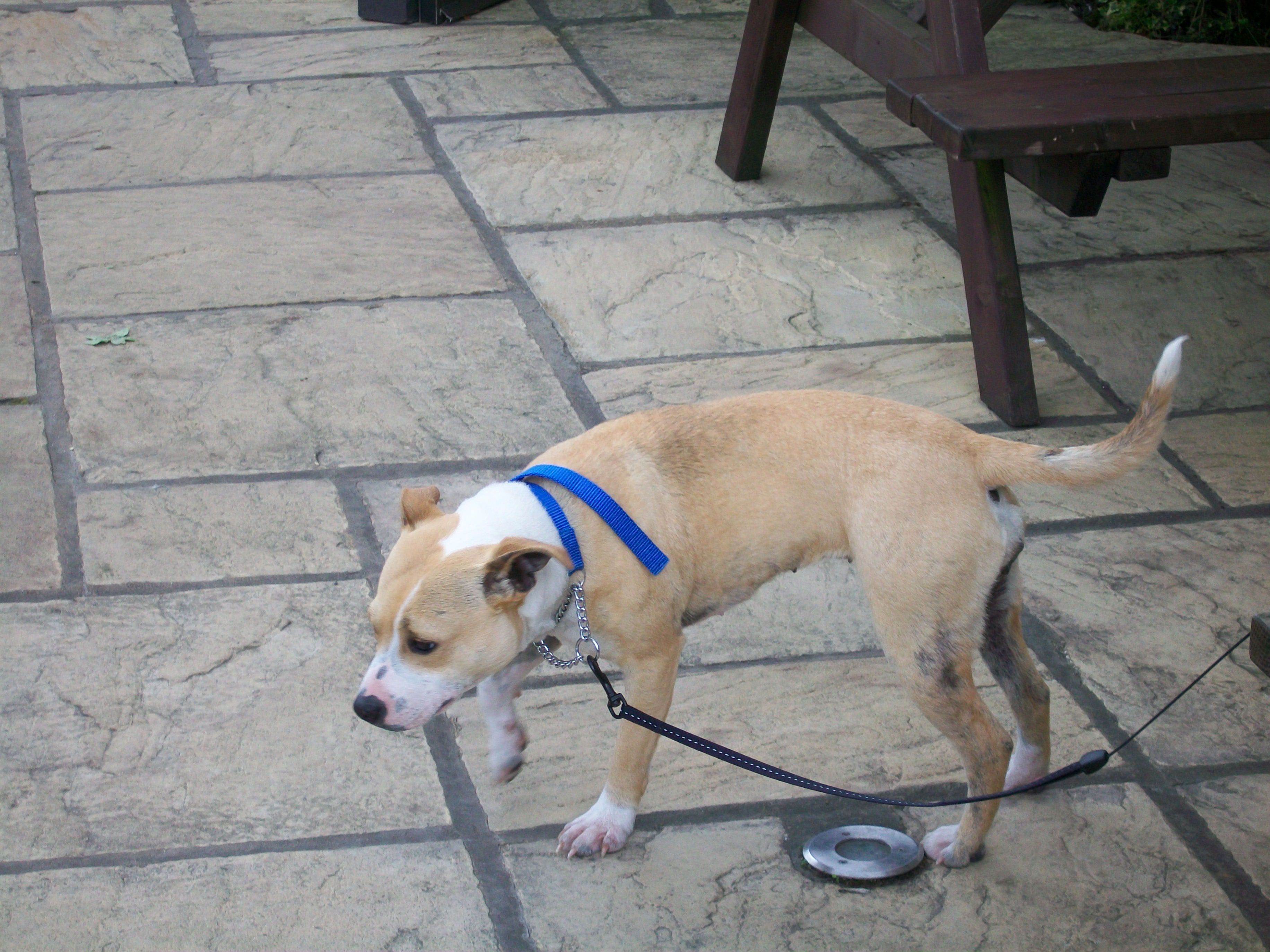
I was impressed by the business-like approach of the RSPCA to their work. I have been one of those who have sometimes felt a bit uncomfortable in the past about the attention and resources some devote to animals, given the awfulness that life offers to some of our fellow human beings around the world. On the other hand dogs can be real friends, both to families and to those living alone, and family pets can help children develop their skills in receiving and giving affection. I strongly suspect also that the people who would be cruel to animals are probably the same people who would be cruel to their fellow human beings, including children. The decent treatment of animals seems to be part of what being civilised is about. I suppose what is needed is a balance in all things.
Wednesday, 17 June 2009
Calman, taxation and representation
In my earlier article on the Calman report, I suggested that the proposal of the report that national rates of income tax as fixed by the UK Parliament should be 10% lower in Scotland than in the remainder of the UK, with the Scottish government and Parliament having the power to make up that missing 10% (and more) with a Scottish income tax to whatever degree it thinks fit, was a sleight of hand with respect to Scottish nationalists.
It is worth mentioning that the same is probably true in relation to those in England or Wales who are concerned by the West Lothian Question, or more generally by constitutional issues concerning the link between taxation and representation.
One of the outcomes of the English civil war was that it finally established that no taxation could be imposed without the authority of Parliament. The King could no longer tax in reliance on the Royal Prerogative, a matter which caused great difficulties to Charles II's administration after the Restoration. This was further entrenched in the Bill of Rights 1689 following the Glorious Revolution, Article 4 of which provides "That levying money for or to the use of the Crown by pretence of prerogative, without grant of Parliament, for longer time, or in other manner than the same is or shall be granted, is illegal".
The need for a link between taxation and representation also formed one of the calls to arms of the revolutionaries in the War of American Independence. The revolutionaries objected to being subject to taxes, and in particular stamp and excise taxes, without representation within the body which fixed them, namely Parliament. In doing so they relied on the Parliamentarian cause in the Civil War that "what an English King has no right to demand, an English subject has a right to refuse" (from the case concerning the extension of Ship Money) and on the rights established by Article 4 of the Bill of Rights. In the period before the outbreak of the Revolutionary War in America, the colonists in objecting to such taxation saw themselves as asserting their rights in defence of the British constitution and the Bill of Rights, rather than acting to subvert that constitution.
The effect of the Calman proposals is that MSPs in the Scottish Parliament must set the rate of income tax for those in Scotland, with the proviso that it is not to be more than 10% below the rate set for the rest of the UK by the UK Parliament (they can set it at any amount above that rate). Since it is pretty well inconceivable that a Scottish government would want to fix a rate of income tax more than 10% below the rate applying elsewhere in the UK, this limitation could be seen as a fig leaf to justify members of the UK Parliament for Scottish constituencies continuing to have a say on the rates of income tax applying outside Scotland. Likewise, the inability of the Scottish Parliament under the proposals to change the differential between higher and lower income tax bands might also be as much to do with keeping some link to the rates of income tax fixed for elsewhere in the UK for West Lothian purposes as with a desire to save the rich in Scotland from unwelcome depredation.
In any event, under the Calman proposals there would be no link to UK rates, for stamp duty land tax, airport passenger tax, aggregates levy and landfill tax applying in Scotland.
Of course, the call of "no taxation without representation" is not necessarily synonymous with "only those representing those paying it are to determine the amount of a tax". What one can say though is that the proposal that the Scottish Parliament should set the rates of income tax, stamp duty land tax, airport passenger tax, aggregates levy and landfill tax applying in Scotland rather than the UK parliament raises constitutional issues for the UK which somewhat belies the Calman Commission's view that it does not need to consider the West Lothian question in making its recommendations, and that it only need concern itself with the position of those in Scotland.
The UK government appears to be taking the line that no referendum in Scotland is required to give effect to the Calman proposals on tax, given that there is already a power for the Scottish Parliament to vary income tax by 3% upwards or downwards so that the principle has already been established. (The original 1998 Act referendum in Scotland covered whether this since unused 3% power should be conferred or not).
However, there is cause to consider whether for constitutional reasons it would be desirable for there to be a referendum within the rest of the UK on the assymetrical taxation autonomy which is now proposed in the report.
It is worth mentioning that the same is probably true in relation to those in England or Wales who are concerned by the West Lothian Question, or more generally by constitutional issues concerning the link between taxation and representation.
One of the outcomes of the English civil war was that it finally established that no taxation could be imposed without the authority of Parliament. The King could no longer tax in reliance on the Royal Prerogative, a matter which caused great difficulties to Charles II's administration after the Restoration. This was further entrenched in the Bill of Rights 1689 following the Glorious Revolution, Article 4 of which provides "That levying money for or to the use of the Crown by pretence of prerogative, without grant of Parliament, for longer time, or in other manner than the same is or shall be granted, is illegal".
The need for a link between taxation and representation also formed one of the calls to arms of the revolutionaries in the War of American Independence. The revolutionaries objected to being subject to taxes, and in particular stamp and excise taxes, without representation within the body which fixed them, namely Parliament. In doing so they relied on the Parliamentarian cause in the Civil War that "what an English King has no right to demand, an English subject has a right to refuse" (from the case concerning the extension of Ship Money) and on the rights established by Article 4 of the Bill of Rights. In the period before the outbreak of the Revolutionary War in America, the colonists in objecting to such taxation saw themselves as asserting their rights in defence of the British constitution and the Bill of Rights, rather than acting to subvert that constitution.
The effect of the Calman proposals is that MSPs in the Scottish Parliament must set the rate of income tax for those in Scotland, with the proviso that it is not to be more than 10% below the rate set for the rest of the UK by the UK Parliament (they can set it at any amount above that rate). Since it is pretty well inconceivable that a Scottish government would want to fix a rate of income tax more than 10% below the rate applying elsewhere in the UK, this limitation could be seen as a fig leaf to justify members of the UK Parliament for Scottish constituencies continuing to have a say on the rates of income tax applying outside Scotland. Likewise, the inability of the Scottish Parliament under the proposals to change the differential between higher and lower income tax bands might also be as much to do with keeping some link to the rates of income tax fixed for elsewhere in the UK for West Lothian purposes as with a desire to save the rich in Scotland from unwelcome depredation.
In any event, under the Calman proposals there would be no link to UK rates, for stamp duty land tax, airport passenger tax, aggregates levy and landfill tax applying in Scotland.
Of course, the call of "no taxation without representation" is not necessarily synonymous with "only those representing those paying it are to determine the amount of a tax". What one can say though is that the proposal that the Scottish Parliament should set the rates of income tax, stamp duty land tax, airport passenger tax, aggregates levy and landfill tax applying in Scotland rather than the UK parliament raises constitutional issues for the UK which somewhat belies the Calman Commission's view that it does not need to consider the West Lothian question in making its recommendations, and that it only need concern itself with the position of those in Scotland.
The UK government appears to be taking the line that no referendum in Scotland is required to give effect to the Calman proposals on tax, given that there is already a power for the Scottish Parliament to vary income tax by 3% upwards or downwards so that the principle has already been established. (The original 1998 Act referendum in Scotland covered whether this since unused 3% power should be conferred or not).
However, there is cause to consider whether for constitutional reasons it would be desirable for there to be a referendum within the rest of the UK on the assymetrical taxation autonomy which is now proposed in the report.
Subscribe to:
Posts (Atom)